Best US States for Digital Nomad Residency: Where to Establish Domicile in 2026
Compare the five best states for digital nomad domicile. Florida, South Dakota, Texas, Nevada, and Wyoming all offer zero state income tax—learn which one fits your nomadic lifestyle best.

If you're planning to embrace the digital nomad lifestyle, one of your first critical decisions isn't about which countries to visit or what gear to pack—it's about where to legally live in the United States.
Even if you plan to spend 365 days per year outside the US, you still need a state of legal domicile. This isn't just a formality. Your domicile state determines whether you pay state income tax, where you vote, which state's laws govern your estate, and where banks expect your residential address.
Choose the wrong state, and you could pay $10,000+ per year in unnecessary state income tax. Choose wisely, and you eliminate that burden entirely while maintaining a compliant, stable legal foundation for your nomadic life.
This guide breaks down the five most popular states for digital nomad domicile, comparing their benefits, requirements, and real-world practicality.
Understanding Domicile vs. Residency: Why It Matters
Before we compare states, you need to understand a critical legal distinction.
| Domicile | Residency |
|---|---|
| Your permanent legal home | Where you currently live or temporarily stay |
| You can only have ONE domicile | You can have multiple residences |
| Based on intent to make it your permanent home | Based on physical presence |
| Determines where you pay state taxes | May trigger additional tax obligations if you spend too many days |
| Requires documentation and legal steps | Simply where you're staying at any given time |
| Used for voting, driver's license, legal purposes | Temporary living situation |
Example: You might have residences in Airbnbs across Thailand, Colombia, and Portugal throughout the year, but your domicile remains Florida—that's your permanent legal home for tax and legal purposes.
Why this matters: Your domicile state can tax your worldwide income. If you maintain domicile in California while traveling, you'll owe California state income tax on every dollar you earn—no matter where in the world you earned it.
For more on the domicile concept: Do Digital Nomads Have to Pay State Taxes?
What Makes a State "Nomad-Friendly"?
Not all states work well for digital nomads. The ideal domicile state offers:
✅ No state income tax (saves $5,000-$15,000+ annually)
✅ Minimal physical presence requirements (you can travel freely)
✅ Straightforward residency process (easy to establish and maintain)
✅ Acceptance of non-traditional addresses (mail forwarding services)
✅ Simple vehicle registration (if you own a car)
✅ No mandatory annual visits (maintain domicile remotely)
✅ Strong asset protection laws (bonus for entrepreneurs)
Five states consistently rank as the best options: Florida, South Dakota, Texas, Nevada, and Wyoming.
Let's break down each one.
Quick Comparison: Best States for Digital Nomad Domicile
| State | Income Tax | Initial Stay Required | Best For |
|---|---|---|---|
| Florida | 0% | None | Most digital nomads, international travelers, snowbirds |
| South Dakota | 0% | 1 night | Full-time RVers, privacy-focused nomads |
| Texas | 0% | 30 days | Those with Texas connections, larger cities preferred |
| Nevada | 0% | 30 days | Western US travelers, those wanting privacy protections |
| Wyoming | 0% | None (but address challenges) | Business owners forming LLCs, privacy seekers |
Now let's examine each state in detail.
#1 Florida: The Gold Standard for Digital Nomad Domicile
Overall Rating: ⭐⭐⭐⭐⭐
Florida has earned its reputation as the most popular domicile state for digital nomads, and for good reason. It combines the strongest tax benefits with the most straightforward requirements and excellent infrastructure for nomadic lifestyles.
Tax Benefits
State income tax: 0%
Estate tax: None
Inheritance tax: None
For someone earning $100,000/year who would otherwise pay California's 9.3% state income tax, moving domicile to Florida saves $9,300 annually. Over a decade, that's $93,000 in your pocket instead of the state's coffers.
Establishing Florida Domicile
The process is refreshingly simple:
Step 1: Obtain a Florida residential address
- Must be a physical street address (not a PO Box)
- Can be a short-term rental, room lease, or professional address service
- Services like NomadPilot provide compliant residential addresses specifically for this purpose
Step 2: Get a Florida driver's license
- Visit any Florida DMV office
- Bring: passport or birth certificate, Social Security card, two proofs of address
- Surrender your out-of-state license
- This is the single most important domicile document
Step 3: Register to vote in Florida
- Can be done online at RegisterToVoteFlorida.gov
- Or in person at the DMV when getting your license
- Strong evidence of intent to make Florida your permanent home
Step 4: File Declaration of Domicile
- File with the Clerk of Court in your Florida county
- Cost: $10-30
- Must be notarized
- Creates official legal record of your domicile date
Step 5: Update all institutions
- Banks and credit cards
- IRS (Form 8822)
- Employer/payroll
- Insurance providers
- Investment accounts
Timeline: You can complete all requirements in a single 3-5 day visit to Florida.
For the complete step-by-step guide: How to Establish Florida Residency as a Digital Nomad
Physical Presence Requirements
None.
Florida has no minimum number of days you must spend in the state annually. You can establish domicile and then travel 365 days per year abroad—as long as you maintain your documentation and don't create competing ties elsewhere.
Vehicle Registration
If you own a vehicle, Florida makes it relatively easy:
✅ No annual vehicle inspection required
✅ Can register by mail after initial setup
✅ Moderate registration fees
✅ No smog check requirement
Contrast this with:
- Texas: Annual safety inspection required
- Nevada: Annual emissions testing in most counties
- Many other states: Must bring vehicle in person annually
Strategic Location
Florida's geography is ideal for international travelers:
- Major international airports: Miami, Fort Lauderdale, Orlando, Tampa
- Direct flights to: Europe, Latin America, Caribbean
- East Coast hub: Convenient for both Atlantic and international travel
- Cruise port access: Multiple departure points for cruises
Asset Protection
Florida offers some of the strongest asset protection laws in the nation:
- Unlimited homestead exemption: Your primary residence is protected from creditors regardless of value
- Strong privacy protections: Favorable for entrepreneurs and business owners
- No state estate or inheritance tax: More wealth passes to heirs
Healthcare Options
Florida provides robust health insurance options through the ACA marketplace, with more plan choices than many other tax-free states. This matters for nomads who need US-based health insurance.
Mail Forwarding Infrastructure
Florida has the most developed mail forwarding industry for nomads, with numerous established services providing:
- Residential address that passes bank verification
- Mail scanning and digital access
- Package forwarding worldwide
- Long-term reliability
NomadPilot's Florida addresses are specifically designed for domicile establishment and include two proofs of address.
Downsides
Residential address requirement: Unlike South Dakota (which accepts mailbox addresses for some purposes), Florida requires a residential street address for driver's license and vehicle registration. However, professional services solve this easily.
Hurricane risk: While this doesn't affect nomads who aren't physically there, it's worth noting for insurance purposes.
Who Florida Is Best For
✅ Digital nomads traveling internationally
✅ High earners leaving high-tax states
✅ Those wanting the simplest, most bulletproof domicile
✅ Frequent international travelers (East Coast/Europe/Latin America)
✅ Anyone who wants maximum flexibility with zero minimum days
Bottom line: For most digital nomads, Florida is the clear winner. The combination of zero state income tax, no physical presence requirement, straightforward process, and excellent support infrastructure makes it the gold standard.
Learn more: Florida Residency Services
#2 South Dakota: The RVer's Choice (With Recent Complications)
Overall Rating: ⭐⭐⭐⭐ (down from ⭐⭐⭐⭐⭐ due to recent changes)
South Dakota has long been the favorite among full-time RVers and those seeking maximum privacy. Recent policy changes have made it less attractive, but it remains a solid option for certain nomads.
Tax Benefits
State income tax: 0%
Estate tax: None
Inheritance tax: None
Business taxes: Generally favorable, especially for LLCs
Establishing South Dakota Domicile
Step 1: Obtain a South Dakota address
- Can use a personal mailbox (PMB) service for most purposes
- More flexible than Florida's residential address requirement
- Many established services cater to RVers and nomads
Step 2: Spend one night in South Dakota
- Must prove with receipt showing your name and South Dakota address
- Hotel, campground, or Airbnb all work
- Requirement applies to everyone in your household establishing residency
Step 3: Get a South Dakota driver's license
- Visit any DMV office during your stay
- Bring standard documentation
- License valid for 5 years
Step 4: Register to vote (if you have a residential address)
- Recent policy change: mailbox addresses can no longer be used for voter registration
- Must have a residential address (apartment, house, or long-term RV spot)
Step 5: Register vehicle (if applicable)
- Can be done entirely online or by mail
- Vehicle does NOT need to be physically in South Dakota
- No annual inspection required
Physical Presence Requirements
One night initially to establish residency, then none ongoing.
However, you must return to South Dakota every 5 years to renew your driver's license in person.
Recent Policy Changes (Important)
South Dakota made several changes in recent years that affect nomads:
Voting restrictions: Personal mailbox addresses can no longer be used for voter registration. You must have a residential address to vote.
Firearm purchases: Cannot use a mailbox address to purchase firearms.
Payroll complications: Some employers cannot use mailbox addresses for payroll tax purposes, making it challenging for W-2 employees and some 1099 contractors.
Impact: These changes make South Dakota less ideal for:
- W-2 employees who need employer payroll compliance
- Those who want to vote and don't want to rent an apartment/RV spot
- Anyone needing a residential address for other legal purposes
Vehicle Registration Advantages
South Dakota remains the easiest state for vehicle registration:
✅ Entirely online or by mail
✅ Vehicle never needs to be in-state
✅ No annual inspection
✅ Low registration fees
✅ Low insurance costs
For RVers and vehicle owners, this is a massive advantage.
Privacy Protections
South Dakota offers strong privacy laws, which appeal to nomads who value discretion in their financial and legal affairs.
Who South Dakota Is Best For
✅ Full-time RVers (especially those with vehicles)
✅ Those willing to maintain a residential address for voting
✅ Self-employed individuals without payroll complications
✅ Privacy-focused nomads
✅ Those who don't mind the initial one-night stay requirement
Bottom line: South Dakota was once the clear #1 for RVers but has fallen to a strong #2 due to recent policy changes. It's still excellent for self-employed nomads with vehicles, but Florida's flexibility edges it out for most situations.
#3 Texas: The 30-Day Entry Barrier
Overall Rating: ⭐⭐⭐⭐
Texas offers excellent tax benefits and a straightforward residency process, but the 30-day initial stay requirement and annual vehicle inspection make it less practical for many nomads.
Tax Benefits
State income tax: 0%
Estate tax: None
Inheritance tax: None
Business taxes: Franchise (margin) tax applies to many businesses, not a traditional corporate income tax
Establishing Texas Domicile
Step 1: Obtain a Texas residential address
- Physical street address required
- Short-term rental, room lease, or address service
Step 2: Spend 30 days in Texas
- This is the critical barrier: you must be physically present for 30 consecutive days before applying for a driver's license
- Proof of address documents (lease, utility bills) must show 30 days of presence
Step 3: Get a Texas driver's license
- Visit DMV after 30-day period
- Standard documentation required
- License valid for 6 years
Step 4: Register to vote
- Can be done when getting license
- Or online through Texas voter registration
Step 5: Register vehicle (if applicable)
- Annual safety inspection required
- This is a major ongoing hassle for nomads
Physical Presence Requirements
30 days initially to establish residency, then none ongoing.
Vehicle Registration Challenges
This is Texas's biggest downside for nomads:
❌ Annual safety inspection required
❌ Difficult to postpone inspections for consecutive years
❌ Requires coordination and paperwork if you're not in Texas
For nomads who own vehicles and travel constantly, this makes Texas impractical.
Strategic Advantages
Large state with diverse cities: Austin, Dallas, Houston, San Antonio offer different vibes and amenities
Central US location: Good for those traveling domestically or to Latin America
Strong economy and infrastructure: Excellent for entrepreneurs and business owners
Who Texas Is Best For
✅ Those who can commit to a 30-day initial stay
✅ Nomads who don't own vehicles
✅ People with existing Texas connections (family, business)
✅ Those who prefer Texas culture and identity
Bottom line: Texas works well if you can handle the 30-day initial requirement and don't own a vehicle. Otherwise, Florida or South Dakota are more practical.
#4 Nevada: The Western Alternative
Overall Rating: ⭐⭐⭐½
Nevada offers solid tax benefits and flexible address requirements but shares Texas's 30-day barrier and has vehicle emissions testing that complicates things for car owners.
Tax Benefits
State income tax: 0%
Estate tax: None
Inheritance tax: None
Business advantages: Strong LLC and trust laws, favorable for asset protection
Establishing Nevada Domicile
Step 1: Obtain a Nevada address
- Physical address required
- Notably flexible: can even use a hotel or extended-stay accommodation
Step 2: Spend 30 consecutive days in Nevada
- Must demonstrate continuous presence
- Hotel, campground, RV park, or rental all work
Step 3: Get a Nevada driver's license
- Visit DMV after 30-day period
- Standard documentation
Step 4: Register to vote
- Can be done with license application
Step 5: Register vehicle (if applicable)
- Annual emissions testing required in most counties (including Clark County/Las Vegas)
Physical Presence Requirements
30 days initially, then none ongoing.
Practical Challenges
Expensive 30-day stay: Hotels and accommodations in major Nevada cities (Las Vegas, Reno) can be costly for a month
Vehicle emissions testing: Annual smog checks required in all major population centers. If you're not in Nevada, this becomes a significant logistical hassle.
Higher insurance and registration costs: Particularly for newer vehicles, Nevada can be more expensive than other tax-free states
Strategic Advantages
Western US location: Good for those traveling in the West or to Asia
Privacy and asset protection: Strong legal frameworks for confidentiality
Gambling and entertainment industry: Unique cultural identity
Who Nevada Is Best For
✅ Those who can afford a 30-day stay
✅ Nomads without vehicles
✅ Western US travelers
✅ Those seeking strong asset protection and privacy laws
Bottom line: Nevada works for specific situations but is generally outclassed by Florida (easier) and South Dakota (better for vehicles). The 30-day requirement and emissions testing are significant barriers.
#5 Wyoming: The LLC Haven with Address Challenges
Overall Rating: ⭐⭐⭐
Wyoming is famous for its business-friendly LLC laws but presents unique challenges for individual domicile establishment, particularly around obtaining a residential address.
Tax Benefits
State income tax: 0%
Corporate income tax: 0%
Estate tax: None
Business formation: Excellent for LLCs, with strong privacy and asset protection
Establishing Wyoming Domicile
The Address Problem:
Wyoming requires a residential street address for a driver's license, but the state is sparsely populated with limited housing options in many areas. This makes it challenging to obtain a legitimate residential address, especially for nomads who aren't actually living there.
Step 1: Obtain a Wyoming residential address
- Physical street address required
- Challenging due to limited options
- Professional services exist but are less developed than Florida or South Dakota
Step 2: Get a Wyoming driver's license
- Visit DMV with proof of address
- Standard documentation
Step 3: Register to vote
- Done with license application
Step 4: Register vehicle (if applicable)
- Relatively straightforward, no annual inspection
Physical Presence Requirements
None officially, but the challenge is getting the residential address in the first place without actually renting or owning property.
Why Wyoming Remains Relevant
LLC formation: Wyoming has some of the best LLC laws in the nation, rivaling Delaware. Many digital nomads form Wyoming LLCs even if they're domiciled elsewhere.
Asset protection: Strong legal protections for business owners and entrepreneurs
Privacy: Favorable laws for those seeking confidentiality
Who Wyoming Is Best For
✅ Business owners forming LLCs (even if domiciled elsewhere)
✅ Those with Wyoming property or connections
✅ Privacy-focused individuals willing to navigate address challenges
Bottom line: Wyoming is hard to recommend for personal domicile establishment due to address challenges. However, it's excellent for business formation. Most nomads will be better served by Florida for domicile while potentially using Wyoming for business entities.
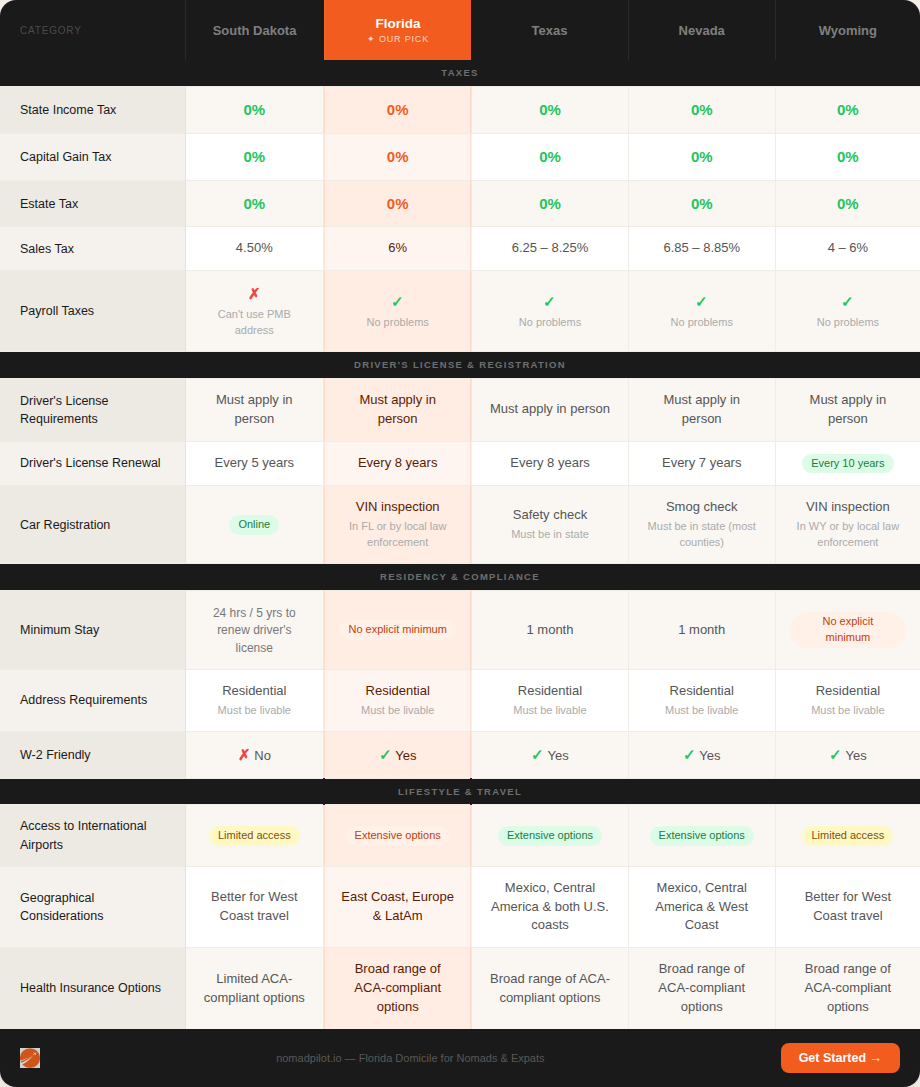
State-by-State Comparison: Key Factors
| Factor | Florida | South Dakota | Texas | Nevada | Wyoming |
|---|---|---|---|---|---|
| Income Tax | 0% | 0% | 0% | 0% | 0% |
| Initial Stay | None | 1 night | 30 days | 30 days | None |
| Address Type | Residential | Mailbox OK | Residential | Residential | Residential |
| Vehicle Inspection | None | None | Annual | Annual (emissions) | None |
| Mail Services | Excellent | Very Good | Good | Limited | Limited |
| Best For | Most nomads | RVers | 30-day stayers | Western travelers | LLC formation |
How to Choose the Right State for Your Situation
Ask yourself these questions:
1. Can you commit to an initial stay?
No initial stay needed: Florida, Wyoming (though address challenges)
1 night: South Dakota
30 days: Texas, Nevada
If you're already traveling and can't spare a month back in the US, Florida is your only practical option among the top states.
2. Do you own a vehicle?
Vehicle-friendly (no annual inspection):
- Florida ✅
- South Dakota ✅ (best for online/mail registration)
- Wyoming ✅
Vehicle complications:
- Texas ❌ (annual safety inspection)
- Nevada ❌ (annual emissions testing)
If you have a car or RV, avoid Texas and Nevada.
3. Do you need to vote?
Full voting rights with any address: Florida, Texas, Nevada, Wyoming
Residential address required for voting: South Dakota (recent change)
4. Are you a W-2 employee?
Works well for employees: Florida, Texas, Nevada, Wyoming
Potential payroll complications: South Dakota (some employers can't use mailbox addresses for payroll tax purposes)
5. Where do you travel most?
International/East Coast/Europe: Florida (best airports and routes)
Western US/Asia: Nevada, Wyoming
Domestic US: Texas (central location), South Dakota
RV travel across US: South Dakota, Florida
6. How important is address simplicity?
Easiest addresses to obtain: Florida (established services), South Dakota (mailbox OK)
More challenging: Wyoming (limited options), Nevada (expensive 30-day stay)
7. What's your budget for initial setup?
Most affordable: South Dakota (1 night stay + low costs)
Moderate: Florida (3-5 day visit, reasonable costs)
More expensive: Texas, Nevada (30-day accommodation costs)
The Verdict: Which State Should You Choose?
For 80% of digital nomads, the answer is Florida.
Here's why:
✅ Zero state income tax
✅ No minimum days requirement
✅ Straightforward 3-5 day setup process
✅ No annual vehicle inspection
✅ Best mail forwarding infrastructure
✅ Declaration of Domicile creates strong legal record
✅ Excellent for international travelers (airports, location)
✅ Strong asset protection laws
✅ No complications with voting, payroll, or banking
Choose South Dakota if:
- You're a full-time RVer who lives in your vehicle
- You want maximum ease for vehicle registration
- You're self-employed (avoiding payroll issues)
- You're comfortable with recent policy changes
Choose Texas if:
- You can commit to 30 days initially
- You don't own a vehicle (or don't mind annual inspections)
- You have Texas connections or prefer Texas culture
Choose Nevada if:
- You're a Western US traveler
- You can afford a 30-day stay
- You don't own a vehicle
- You want strong privacy protections
Choose Wyoming if:
- You're forming an LLC (even if domiciled elsewhere)
- You have Wyoming property or strong connections
- You're willing to navigate address challenges
How to Establish Florida Domicile: Your Action Plan
Since Florida is the best choice for most nomads, here's your simplified roadmap:
30-60 Days Before Your Visit
- Secure a Florida residential address
- Use NomadPilot for a compliant residential address with proofs
- Or arrange a short-term rental/room lease
- Gather required documents
- Passport or birth certificate
- Social Security card
- Two proofs of Florida address
- Proof of termination from old state (if applicable)
- Schedule your Florida visit
- Plan for 3-5 days
- Research DMV locations and hours
- Consider timing around other travel
During Your Florida Visit (3-5 Days)
Day 1: Arrive, check into accommodation, activate your address
Day 2:
- Visit DMV for driver's license
- Surrender old state license
- Register to vote (can often do at DMV)
Day 3:
- File Declaration of Domicile with county Clerk of Court
- Open a Florida bank account (optional but helpful)
- Update insurance policies
Day 4:
- Register vehicle if applicable
- Handle any remaining documentation
- Confirm all documents are in order
Day 5: Buffer day for any issues, or depart
After Your Visit (Remote)
- Update all institutions with your new address
- All banks and credit cards
- Brokerage and investment accounts
- IRS (Form 8822)
- Social Security Administration
- Employer/payroll
- Insurance providers
- Professional licenses
- File final tax return with old state
- Part-year resident return
- Clearly indicate move date
- Include new Florida address
- Set up mail forwarding
- Activate scanning and forwarding service
- Update preferred mailing address with all institutions
- Maintain documentation
- Keep copies of all Florida documents
- Save receipts from your visit
- Document timeline of your move
For complete details: How to Establish Florida Residency as a Digital Nomad
Common Mistakes to Avoid When Changing Domicile
Mistake #1: Not Severing Ties with Your Old State
Changing domicile isn't just about establishing yourself in a new state—you must also clearly cut ties with your old one.
Actions required:
- Surrender old state driver's license
- Cancel old state voter registration
- File final part-year tax return
- Close or sell property in old state (or document it as investment/rental property)
- Update all addresses to new state
- Minimize time spent in old state going forward
For more: How to Change Your State Residency When You Travel Full-Time
Mistake #2: Using a PO Box or Commercial Mail Drop
Many states (including Florida, Texas, and Nevada) require a residential street address for driver's licenses and vehicle registration.
Solution: Use a professional service like NomadPilot that provides legitimate residential addresses that pass verification.
Mistake #3: Not Filing a Declaration of Domicile
In Florida, filing a Declaration of Domicile creates an official legal record of when you established domicile. This becomes critical evidence if your old state ever challenges your move.
Always file this document when establishing Florida domicile.
Mistake #4: Keeping Voter Registration in Multiple States
You can only be registered to vote in one state. Maintaining registration in your old state undermines your domicile claim.
Solution: Cancel old registration when you register in your new state.
Mistake #5: Not Maintaining Your Domicile
Once established, you must maintain your domicile by:
- Keeping your address active (mail forwarding service)
- Renewing driver's license on time
- Filing tax returns using your domicile address
- Not creating competing ties in other states
Related: What Address Should Digital Nomads Use for Banking and Taxes?
How NomadPilot Simplifies Florida Domicile
Establishing and maintaining Florida domicile involves logistics: getting an address that passes verification, managing mail while abroad, staying compliant with renewals and updates.
NomadPilot handles all of this:
Compliant Florida Residential Address
Get a legitimate street address that passes DMV, bank, and IRS verification—not a PO Box or commercial mail drop.
Two Proofs of Address Included
Receive the documentation you need for your DMV appointment, saving time and avoiding rejections.
Step-by-Step Domicile Guidance
Follow a clear roadmap with checklists, document templates, and instructions for each step of establishing Florida residency.
Mail Scanning & Worldwide Forwarding
Never miss important mail while traveling. We receive, scan, and forward your documents anywhere in the world.
Declaration of Domicile Support
Get help preparing and filing your Declaration of Domicile to create a strong legal record.
Ongoing Maintenance
Reminders for license renewals, address updates, and annual compliance to maintain your domicile long-term.
Expat Tax Professional Network
Connect with vetted CPAs who understand digital nomad tax situations and can file your returns correctly.
Learn more: NomadPilot Florida Residency Services
FAQ: Choosing a State for Digital Nomad Domicile
What is the fastest state to establish residency in?
Florida and South Dakota are tied for fastest. Florida requires no minimum stay and can be completed in 3-5 days. South Dakota requires only one night initially but you must return every 5 years to renew your license in person.
Can I establish residency in a state without ever living there?
Yes, for states like Florida with no minimum physical presence requirement. You need to visit once to get your driver's license in person, but after that, you can maintain domicile while traveling full-time.
Do I have to pay taxes in my old state after I move?
Only through the date you established domicile in your new state. You'll file a part-year resident return with your old state showing income earned while domiciled there. After your move date, you only owe tax to your new state (or no state tax if you chose Florida, Texas, etc.).
What if my old state audits my domicile change?
This is most common when leaving high-tax states like California or New York. You'll need to provide documentation proving you established domicile elsewhere: driver's license, voter registration, Declaration of Domicile, updated bank accounts, minimal time spent in old state, etc. Proper documentation from the start prevents problems.
Can I vote if I'm domiciled in Florida but traveling abroad?
Yes. You can request absentee ballots and vote from anywhere in the world. Your domicile state is where you're registered to vote, regardless of physical location.
How often do I need to return to my domicile state?
Florida: Never required, though occasional visits strengthen your claim
South Dakota: Every 5 years to renew driver's license in person
Texas, Nevada, Wyoming: Varies, but generally not required after initial establishment
What if I own property in my old state?
Owning property doesn't automatically disqualify you from changing domicile, but you must document it as rental or investment property (not your primary residence). The property should be rented out or clearly used for purposes other than your permanent home.
Can I change my domicile multiple times?
Yes, though frequent changes may raise red flags during audits. Each time you change, you must properly establish the new domicile and sever ties with the old one.
What about health insurance when I change states?
Changing domicile is a qualifying life event that allows you to change health insurance plans mid-year. You can enroll in an ACA marketplace plan in your new state or use expat health insurance.
Conclusion: Choose Wisely, Save Thousands
Your choice of domicile state is one of the most impactful financial decisions you'll make as a digital nomad.
Choose wrong—or fail to change from a high-tax state—and you'll pay $5,000-$15,000+ annually in unnecessary state income tax.
Choose wisely, and you'll eliminate that burden entirely while creating a stable, compliant legal foundation for your nomadic lifestyle.
For most digital nomads, Florida is the clear winner: zero tax, zero minimum days, straightforward process, excellent infrastructure, and maximum flexibility.
The investment to establish domicile properly ($1,000-$2,000 including address service, travel, and setup costs) pays for itself within the first few months through state tax savings.
Don't let confusion or procrastination cost you thousands. Take action now to establish your domicile, eliminate state income tax, and build a proper legal foundation for full-time travel.
Ready to establish Florida residency and start saving on state taxes?
Visit NomadPilot.io to get your Florida residential address, step-by-step guidance, Declaration of Domicile support, and mail forwarding—everything you need to establish the perfect domicile for your digital nomad lifestyle.