5 Easiest States to Establish Residency for Digital Nomads (2026 Guide)
Compare the 5 easiest states to establish residency for digital nomads. Florida leads with zero minimum stay, straightforward process, and excellent infrastructure. Learn which state fits your situation.
If you're embracing the digital nomad lifestyle or planning to live abroad as an expat, one decision will save you more money than almost any other: where you establish legal state residency.
Choose wisely, and you'll eliminate $5,000-$15,000+ in annual state income tax while maintaining a stable legal home base. Choose poorly, and you could face double taxation, compliance nightmares, and administrative headaches that haunt you for years.
The problem? Most states make residency establishment complicated, time-consuming, or financially disadvantageous. High-tax states like California, New York, and Massachusetts actively try to prevent you from leaving, using "sticky residency" rules to keep taxing you even after you move.
This comprehensive guide breaks down the five easiest states to establish residency for digital nomads and expats—states that combine straightforward processes, favorable tax treatment, and infrastructure designed for location-independent living.
We'll compare requirements, costs, and practical considerations so you can make an informed decision. Spoiler: Florida wins for most nomads, and we'll show you exactly why.
Understanding State Residency vs. Domicile
Before diving into specific states, let's clarify critical legal terminology that confuses even experienced nomads.
Residency vs. Domicile: The Legal Difference
Residency: Where you currently live, temporarily or permanently. You can have multiple residences (Airbnb in Mexico City, apartment in Barcelona, hotel in Bangkok).
Domicile: Your permanent legal home—the state you intend to return to and consider your legal residence, even if you're never physically there.
According to legal precedent established in cases like Mitchell v. United States and various state Supreme Court rulings:
| Domicile | Residency |
|---|---|
| Your permanent legal home | Where you currently stay temporarily |
| You can only have ONE domicile | You can have multiple residences |
| Based on intent to make it permanent home | Based on physical presence |
| Determines state tax obligations | May trigger additional tax if too many days |
| Difficult to change (requires documentation) | Changes simply by moving |
| Used for voting, taxes, estate law | Temporary living situation |
Why this matters: Your domicile state can tax your worldwide income, regardless of where you physically earn it. If you keep California domicile while traveling, California taxes every dollar you make—even if you're in Bali, Barcelona, or Buenos Aires.
For more context: Do Digital Nomads Have to Pay State Taxes?
What Makes a State "Easy" to Establish Residency?
The easiest states combine:
✅ No state income tax (saves $5,000-$15,000+ annually)
✅ Minimal physical presence requirements (travel freely)
✅ Straightforward documentation process (no bureaucratic nightmares)
✅ Acceptance of non-traditional addresses (mail forwarding services)
✅ No mandatory annual visits (maintain remotely)
✅ Simple vehicle registration (if you own a car)
✅ Stable, predictable rules (no surprise policy changes)
Only five states consistently meet these criteria: Florida, South Dakota, Texas, Nevada, and Wyoming.
Quick Comparison: The 5 Easiest States
| State | Income Tax | Min. Stay | Difficulty | Best For |
|---|---|---|---|---|
| Florida | 0% | None | ⭐⭐⭐⭐⭐ Easiest | Most digital nomads |
| South Dakota | 0% | 1 night | ⭐⭐⭐⭐ Easy | Full-time RVers |
| Texas | 0% | 30 days | ⭐⭐⭐ Moderate | Those with TX connections |
| Nevada | 0% | 30 days | ⭐⭐⭐ Moderate | Western US travelers |
| Wyoming | 0% | None | ⭐⭐ Challenging | LLC formation |
Verdict preview: Florida wins for 80% of digital nomads due to maximum flexibility, zero minimum stay, excellent infrastructure, and stable long-term rules.
Let's examine each state in detail.
#1 Florida: The Best Overall Choice for Digital Nomads ⭐⭐⭐⭐⭐
Overall Rating: 5/5 — The gold standard for digital nomad residency
Florida consistently ranks as the #1 easiest state to establish residency, and for good reason. It combines the most favorable tax treatment with the simplest process and best infrastructure for location-independent living.
Why Florida Is the Easiest State
Zero state income tax
According to the Tax Foundation, Florida is among nine states with no individual income tax. This means:
- No tax on wages, salaries, or self-employment income
- No tax on investment income (dividends, interest, capital gains)
- No tax on retirement distributions
- No tax on rental income from properties
Example savings: Earn $100,000/year and move domicile from:
- California (9.3%) → Save $9,300/year
- New York (6.5%) → Save $6,500/year
- Massachusetts (5%) → Save $5,000/year
Over 10 years traveling, that's $50,000-$93,000 saved.
No minimum stay requirement
Unlike Texas (30 days) or South Dakota (1 night), Florida has zero minimum physical presence requirement. You can establish domicile in a single 3-5 day visit for your driver's license, then travel 365 days/year indefinitely.
According to Florida Statutes § 222.17, intent—not physical presence—determines domicile.
No estate or inheritance tax
Florida exempts estates from state-level taxation, according to AARP estate planning resources. This matters for high net worth individuals planning long-term wealth transfers.
Straightforward process
Establishing Florida domicile requires just four simple steps:
- Obtain Florida residential address (via service like NomadPilot or short-term lease)
- Get Florida driver's license (in-person DMV visit, surrender old license)
- Register to vote (optional but recommended)
- File Declaration of Domicile (county Clerk of Court, $10-30)
Complete guide: How to Establish Florida Residency as a Digital Nomad
Timeline: Everything can be completed in a single 3-5 day visit to Florida.
No annual vehicle inspection
Unlike Texas, Florida doesn't require annual safety inspections. Unlike Nevada, no emissions testing. This makes vehicle ownership significantly easier.
Excellent mail forwarding infrastructure
Florida has the most developed mail forwarding industry for digital nomads, with dozens of services providing:
- Real residential addresses (not commercial mail drops)
- Professional mail scanning and forwarding
- Package handling worldwide
- Bank/DMV-compliant documentation
Superior international airport access
Florida's geography makes visits easy and affordable:
- Miami International (MIA) — Gateway to Latin America, Europe
- Fort Lauderdale (FLL) — Low-cost carrier hub
- Orlando (MCO) — Major international connections
- Tampa (TPA) — Growing international service
According to Bureau of Transportation Statistics, Florida airports rank in the top 10 for international passenger traffic.
Strong asset protection laws
Florida offers unlimited homestead exemption—your primary residence is protected from creditors regardless of value, according to Florida Constitution Article X.
Florida's Requirements in Detail
Address: Must have residential street address (not PO Box). Services like NomadPilot provide compliant residential addresses with signed leases.
Driver's license: In-person DMV visit required initially. Bring passport, Social Security card, two proofs of Florida address. Valid 8 years, can often renew by mail.
Voter registration: Optional but strengthens domicile claim. Can register online at RegisterToVoteFlorida.gov or at DMV.
Declaration of Domicile: File with county Clerk of Court. Creates legal record of your intent. Critical for defending against former state's tax claims.
Vehicle registration (if applicable): Register in person initially, then by mail. No annual inspection required.
Florida's Minor Downsides
Residential address requirement: Unlike South Dakota (which allows mailboxes for some purposes), Florida requires residential addresses. However, professional services like NomadPilot solve this completely.
Hurricane risk: While nomads aren't physically there during hurricane season, it's worth noting for insurance purposes.
Who Florida Is Perfect For
✅ International digital nomads
✅ Remote W-2 employees
✅ High earners leaving high-tax states
✅ Anyone wanting maximum flexibility
✅ Non-vehicle owners
✅ Frequent international travelers
✅ Those prioritizing long-term stability
How NomadPilot Makes Florida Residency Effortless
Establishing Florida residency requires proper infrastructure—address, documentation, and ongoing mail management.
NomadPilot provides:
- Florida residential address that passes bank/DMV verification
- Signed lease agreement for proof of residency
- Optional utility bill for premium verification
- Mail scanning and worldwide forwarding
- Declaration of Domicile support and filing guidance
- Step-by-step residency establishment checklist
- Access to expat tax professionals
Learn more: NomadPilot Florida Residency Services
Bottom line: Florida is the easiest, most flexible, and best-supported state for digital nomad residency. For 80% of nomads, it's the clear winner.
#2 South Dakota: Best for RVers (With Recent Complications) ⭐⭐⭐⭐
Overall Rating: 4/5 — Excellent for RVers, complicated by recent policy changes
South Dakota has long been the favorite among full-time RVers due to easy vehicle registration and mailbox-friendly policies. However, recent legislative changes have created challenges.
Why South Dakota Is Easy
Zero state income tax: Like Florida, South Dakota has no personal income tax, saving thousands annually.
Minimal initial presence: One-night stay required (must provide receipt showing your name and South Dakota address from hotel, campground, or Airbnb).
100% remote vehicle registration: You can register vehicles entirely online or by mail—vehicle never needs to enter South Dakota. This is unique and hugely valuable for RVers.
Traditionally mailbox-friendly: PMB (personal mailbox) addresses worked for driver's license and vehicle registration.
Lower costs: Generally cheaper than Florida for registration fees, insurance, and address services.
Recent Policy Changes (Critical)
South Dakota passed several restrictions in 2023-2024:
1. Voting restrictions: PMB addresses can no longer be used for voter registration. Must have residential address (apartment, house, RV spot) to vote.
2. Firearm purchases: Cannot use mailbox address—residential address required.
3. Payroll complications: Mailbox addresses cannot be used for certain employment tax purposes (unemployment insurance). Some employers refuse W-2 payroll with PMB addresses.
4. One-night proof requirement: Must provide receipt with names and South Dakota address for all household members.
Source: South Dakota DMV
Who These Changes Affect
❌ W-2 remote employees (payroll issues)
❌ Anyone wanting to vote (must rent residential space)
❌ Those needing firearm access
✅ Still works for: Self-employed nomads, RVers with vehicles, those not voting
South Dakota Requirements
Address: PMB/mailbox acceptable for driver's license and vehicle registration (though limited for other purposes due to recent changes).
One-night stay: Must spend one night and provide proof.
Driver's license: In-person during visit. Valid 5 years, must renew in person (return every 5 years).
Vehicle registration: 100% online/by mail. Huge advantage for RV owners.
South Dakota's Downsides
Recent policy restrictions reducing flexibility
Limited international airports (Sioux Falls regional only)
Less developed for international digital nomads (infrastructure focuses on domestic RV community)
In-person renewal every 5 years (Florida is 8 years, often by mail)
Banking complications (some banks flag PMB addresses)
Who South Dakota Is Best For
✅ Full-time RVers with multiple vehicles
✅ Self-employed nomads
✅ Domestic US travelers
✅ Those not planning to vote
For most international digital nomads, Florida is now better than South Dakota due to policy stability and infrastructure.
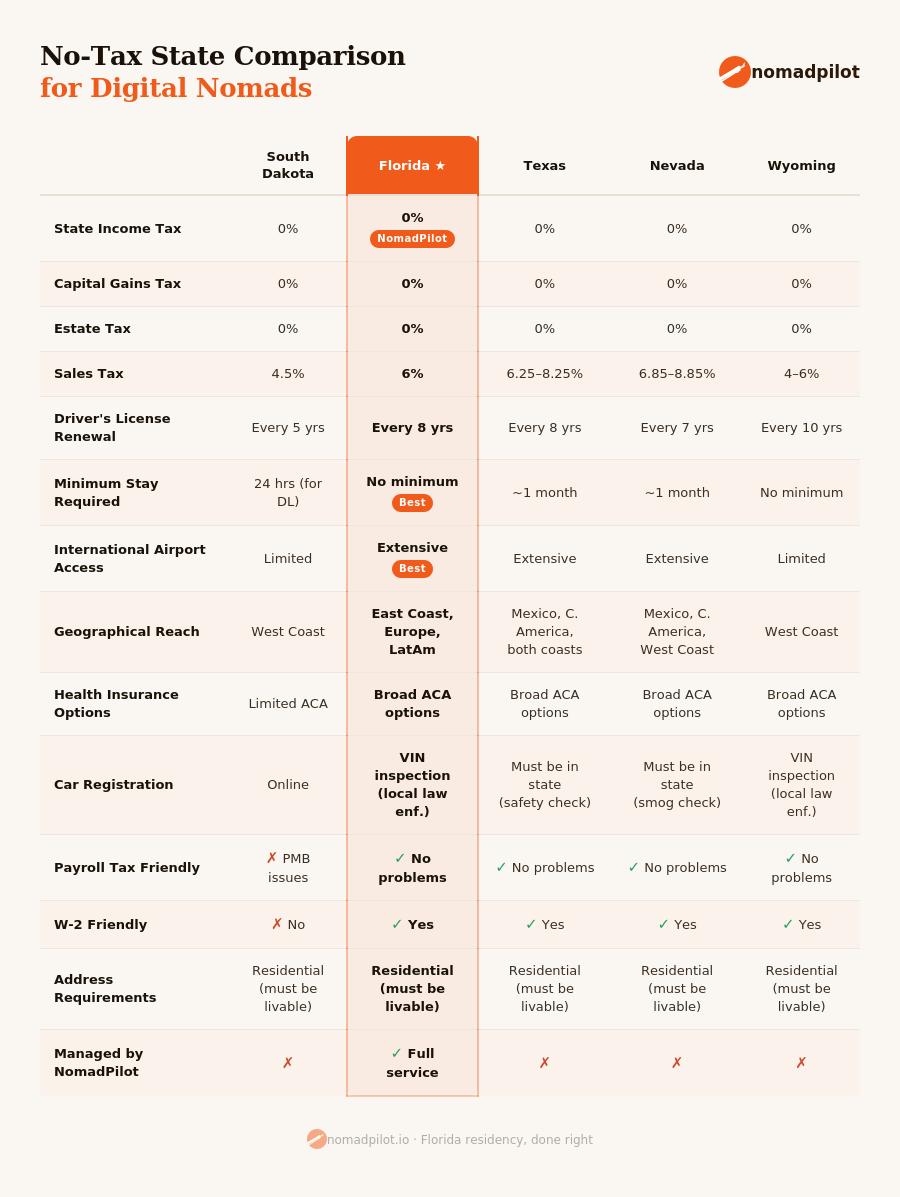
Comparison: Florida vs South Dakota Domicile for Digital Nomads
#3 Texas: Good If You Can Handle the 30-Day Requirement ⭐⭐⭐
Overall Rating: 3/5 — Straightforward but hampered by initial stay requirement
Texas offers excellent tax benefits and a clear residency process, but the 30-day initial presence requirement makes it impractical for many nomads.
Why Texas Can Work
Zero state income tax: No personal income tax, no estate/inheritance tax.
Straightforward process: Clear steps—get driver's license, register to vote, establish address.
Strong economy: Large state with diverse cities (Austin, Dallas, Houston, San Antonio).
Central US location: Good for domestic travel or trips to Latin America.
No minimum ongoing presence: After initial 30 days, travel freely.
Texas's Critical Barrier
30-day physical presence requirement
According to Texas DPS, you must be physically present in Texas for 30 consecutive days before applying for a driver's license or state ID.
Your proof of address documents (lease, utility bills) must show 30 days of presence.
This means:
- You cannot quickly establish Texas residency
- Must commit to a month-long stay
- Accommodation costs for 30 days
- Not practical if you're already traveling
Texas's Vehicle Problem
Annual safety inspection required: Every vehicle registered in Texas must undergo annual safety inspection. While postponement is possible, consecutive postponements become increasingly difficult.
This makes Texas impractical for nomads with vehicles who aren't regularly in Texas.
Texas Requirements
30-day stay: Must prove with dated documents (lease, utility bills, etc.).
Driver's license: Get after 30 days, valid 6 years.
Vehicle inspection: Annual requirement (major hassle for nomads).
Who Texas Works For
✅ Those who can commit to 30 days initially
✅ Non-vehicle owners
✅ People with Texas family/connections
✅ Those preferring Texas culture
For most digital nomads already traveling, Florida's zero-day requirement beats Texas's 30-day requirement.
#4 Nevada: Western Alternative With 30-Day Barrier ⭐⭐⭐
Overall Rating: 3/5 — Decent option with significant obstacles
Nevada shares Texas's 30-day requirement and adds expensive emissions testing for vehicles.
Why Nevada Works
Zero state income tax: No personal income tax.
Flexible address definition: Can use hotel address if you demonstrate 30 consecutive days.
Strong asset protection: Excellent trust laws and privacy protections.
Western US location: Good for those traveling in Western states or to Asia.
Nevada's Challenges
30-day presence requirement: Must demonstrate 30 consecutive days in Nevada before getting driver's license.
Expensive 30-day stay: Hotels and accommodations in Las Vegas/Reno can be costly for a month.
Annual emissions testing: Most counties (including Clark County/Las Vegas) require annual smog checks. Major hassle for nomads with vehicles.
Higher vehicle costs: Registration fees and insurance often more expensive than Florida or South Dakota.
Limited international airports: Primarily Las Vegas; fewer international connections than Florida.
Nevada Requirements
30-day stay: In hotel, campground, RV park, or rental.
Driver's license: Get after 30-day period.
Vehicle emissions: Annual testing required in major population centers.
Who Nevada Works For
✅ Western US travelers
✅ Those who can afford 30-day Vegas stay
✅ Non-vehicle owners
✅ Privacy-focused individuals
For most nomads, Florida's flexibility and zero-day requirement makes it superior to Nevada.
#5 Wyoming: Great for LLCs, Challenging for Personal Residency ⭐⭐
Overall Rating: 2/5 — Not recommended for personal domicile
Wyoming has excellent business laws but presents significant challenges for establishing personal residency.
Why Wyoming Is Difficult
Address challenge: Requires residential street address for driver's license, but Wyoming is sparsely populated with limited housing options in many areas.
Hard to find compliant address: Professional domicile services less developed than Florida or South Dakota.
No advantages over other states: Tax benefits identical to Florida, South Dakota, Texas.
Why Wyoming Remains Relevant
Excellent for LLC formation: Wyoming has some of the best LLC laws in the nation, rivaling Delaware. Many nomads form Wyoming LLCs even if domiciled elsewhere.
Strong asset protection: Favorable for business owners and entrepreneurs.
Privacy laws: Strong confidentiality protections.
No state corporate income tax: Benefits businesses.
Wyoming Requirements
Residential address: Must obtain (challenging due to limited options).
Driver's license: In-person visit with proof of address.
Vehicle registration: Straightforward, no annual inspection.
Who Wyoming Works For
✅ Those forming LLCs (even if domiciled elsewhere)
✅ People with Wyoming property/family
✅ Privacy-focused individuals willing to navigate address challenges
For personal domicile, Florida is far easier than Wyoming. However, consider Wyoming for LLC formation while maintaining Florida domicile.
State-by-State Detailed Comparison
| Factor | FL | SD | TX | NV | WY |
|---|---|---|---|---|---|
| Min. Stay | None | 1 night | 30 days | 30 days | None |
| Address Type | Residential | PMB OK | Residential | Residential | Residential |
| Vehicle Inspect. | None | None | Annual | Annual | None |
| License Renewal | 8 yrs, mail OK | 5 yrs, in-person | 6 years | 8 years | 4 years |
| W-2 Friendly | Yes | Limited | Yes | Yes | Yes |
| Voting Easy | Yes | Needs residential | Yes | Yes | Yes |
| Mail Services | Excellent | Good | Good | Limited | Limited |
| Intl Airports | Excellent | Limited | Good | Good (LV) | Limited |
| Policy Stability | Excellent | Recent issues | Stable | Stable | Stable |
Your Decision Framework: Which State Should You Choose?
Answer these questions to identify your best option:
Question 1: Can you commit to an initial stay?
No initial stay possible → Florida or Wyoming
Can do 1 night → Add South Dakota as option
Can do 30 days → Texas and Nevada become options
Winner: Florida (zero days required)
Question 2: Do you own a vehicle?
Yes, and it's an RV → South Dakota (100% remote registration)
Yes, regular vehicle → Florida (no inspection) or South Dakota
No vehicle → Florida wins (address requirement doesn't matter)
Winner: South Dakota for RVers, Florida for non-vehicle owners
Question 3: What's your employment situation?
W-2 remote employee → Florida (no payroll issues)
Self-employed/freelance → Florida or South Dakota
Retired → Either works, Florida easier
Winner: Florida (universal acceptance)
Question 4: Where do you travel?
Primarily international → Florida (best airports)
Primarily domestic/RV → South Dakota or Texas
Western US focus → Nevada or Wyoming
Winner: Florida for international, South Dakota for domestic RV
Question 5: Do you want to vote?
Yes, important to me → Florida (no restrictions)
Not a priority → Any state works
Winner: Florida (no complications)
Question 6: What's your priority?
Maximum flexibility → Florida
Lowest cost → South Dakota (marginally)
Easiest vehicle registration → South Dakota
Best long-term stability → Florida
Winner: Florida for most priorities
Why Florida Wins for Most Digital Nomads
After analyzing all five states, Florida emerges as the best choice for 80% of digital nomads because:
✅ Zero minimum stay (easiest initial setup)
✅ No recent policy complications (stable rules)
✅ Best international airport access (easy visits)
✅ Excellent mail forwarding infrastructure (designed for nomads)
✅ Universal bank acceptance (residential addresses)
✅ W-2 employment compatible (no payroll issues)
✅ No voting restrictions (full rights)
✅ 8-year license, mail renewal (lowest maintenance)
✅ No vehicle inspection (if you own vehicles)
✅ Comprehensive support services (NomadPilot and others)
The only scenarios where other states win:
- South Dakota: You're a full-time RVer with multiple vehicles
- Texas: You have strong Texas connections and can do 30 days
- Nevada: You're focused on Western US travel and can do 30 days
- Wyoming: You're forming an LLC (even if domiciled elsewhere)
For everyone else: Florida is the clear winner.
How to Establish Florida Residency: Your Action Plan
Ready to establish Florida domicile and start saving thousands in state income tax? Here's your step-by-step roadmap.
Step 1: Secure a Florida Residential Address (Before Your Visit)
Option 1: Use NomadPilot (Recommended)
- Get compliant residential address immediately
- Receive signed lease agreement
- Optional utility bill in your name
- Mail forwarding included
- Designed specifically for nomad residency
Option 2: Short-term rental
- Rent room or apartment for 1-3 months
- Get lease in your name
- Use as proof of address
Option 3: Family/friend address
- Must be willing to help long-term
- Proper documentation required
- Consider tax implications for their state
Learn more: NomadPilot Florida Residency Services
Step 2: Plan Your Florida Visit (3-5 Days)
30-60 days before visit:
- Secure Florida address
- Gather documents (passport, Social Security card, birth certificate)
- Schedule DMV appointment (optional but recommended)
- Book accommodation
During your visit:
- Day 1: Arrive, check into accommodation
- Day 2: DMV visit for driver's license (surrender old license)
- Day 3: File Declaration of Domicile with county Clerk of Court
- Day 3-4: Register to vote, open bank account (optional)
- Day 4-5: Register vehicle if needed, handle final items
Step 3: Get Your Florida Driver's License
What to bring to DMV:
- Passport or birth certificate (proof of identity)
- Social Security card
- Two proofs of Florida residential address
- Lease agreement from NomadPilot
- Bank statement with Florida address
- Or other acceptable documents
What happens:
- Surrender out-of-state license
- Pass vision test
- Photo and signature
- Receive temporary paper license (plastic arrives in mail)
Cost: $54 for 8-year license
Step 4: File Declaration of Domicile
What it is: Legal document declaring your intent to make Florida your permanent home
Where to file: County Clerk of Court in your Florida county
Cost: $10-30
Why it matters: Creates official legal record of domicile date, critical evidence if former state challenges your move
How NomadPilot helps: Provides document template and filing guidance
Step 5: Register to Vote (Recommended)
Online: RegisterToVoteFlorida.gov
In person: At DMV when getting license
Why it matters: Strong evidence of intent to make Florida your permanent home
Step 6: Update All Institutions
Critical updates:
- IRS (Form 8822 - Change of Address)
- All banks and credit cards
- Investment/brokerage accounts
- Insurance providers (auto, health, life)
- Employer/payroll
- Social Security Administration
Use your Florida address everywhere
Step 7: File Final Tax Return with Old State
If leaving a high-tax state:
- File part-year resident return
- Show income earned while resident (Jan 1 to move date)
- Include Florida address
- Declare domicile change date
This creates clean break and starts statute of limitations clock
Related: How to Change Your State Residency When You Travel Full-Time
Step 8: Maintain Your Florida Domicile
While traveling:
- Keep Florida driver's license current (renew by mail)
- Maintain Florida address (via NomadPilot mail forwarding)
- Use Florida address on all tax returns
- Don't establish competing domicile elsewhere
- Visit Florida occasionally if practical (not required)
Complete guide: How to Establish Florida Residency as a Digital Nomad
Common Questions About Establishing State Residency
Which state is truly the easiest to establish residency?
Florida is objectively the easiest for most digital nomads because it requires zero minimum stay (vs 1 night for South Dakota, 30 days for Texas/Nevada), has no recent policy complications, and offers the best support infrastructure.
Can I establish residency without physically visiting?
No. All five states require at least one in-person visit to obtain a driver's license. Florida requires one 3-5 day visit, then you can maintain residency remotely indefinitely.
Do I need to return to my domicile state annually?
No. Florida has zero minimum days-per-year requirement. You can travel 365 days/year abroad and maintain Florida domicile as long as you don't establish competing ties elsewhere.
How do I prove I've established new residency to my old state?
Document everything: new driver's license, voter registration, Declaration of Domicile, updated bank accounts, final part-year tax return. Keep a file with copies of all documents showing your move date.
Can I switch states later if I change my mind?
Yes. You can change domicile at any time by establishing residency in a new state and filing appropriate tax returns. Many nomads start with South Dakota, then switch to Florida due to policy changes.
What if I spend significant time in another state while traveling?
As long as you don't spend more than 183 days in any other state and don't establish domicile there (get license, register to vote, etc.), your Florida domicile remains valid.
Do I pay taxes in both my old and new state during the transition year?
You file a part-year resident return with both states. Old state gets income from Jan 1 through your move date. New state gets income after move date (though Florida has no income tax, so just informational).
Is Florida really better than South Dakota for digital nomads?
For most digital nomads—especially international travelers and W-2 employees—yes. Florida offers superior infrastructure, no policy complications, better airports, and more flexibility. South Dakota still wins for full-time RVers with vehicles.
Can I use a PO Box for any of these states?
No. All five states require residential street addresses for driver's licenses. Services like NomadPilot provide compliant residential addresses that aren't PO Boxes.
Conclusion: Choose Florida, Use NomadPilot, Start Saving
After comparing all five easiest states to establish residency, the verdict is clear: Florida is the best choice for the vast majority of digital nomads and expats.
Why Florida wins:
- Easiest setup (zero minimum stay)
- Best long-term stability (no policy surprises)
- Superior infrastructure (mail services, airports, support)
- Maximum flexibility (no restrictions on voting, employment, etc.)
- Proven track record (decades of nomad-friendly policies)
The other states work for specific niches:
- South Dakota: Full-time RVers (despite recent issues)
- Texas/Nevada: Those with regional connections who can do 30 days
- Wyoming: LLC formation (separate from personal domicile)
The ROI is massive: Saving $5,000-$15,000 annually in state income tax means the cost of proper setup ($1,000-$2,000 via NomadPilot) pays for itself within the first few months.
Don't delay: Every month you maintain domicile in a high-tax state costs you hundreds or thousands of dollars. Establish Florida residency now and start saving immediately.
Make it simple with NomadPilot: Get your Florida residential address, signed lease, Declaration of Domicile support, mail forwarding, and complete guidance—everything you need to establish the easiest, most effective domicile for your digital nomad lifestyle.
Ready to establish Florida residency and eliminate state income tax?
Visit NomadPilot.io to get started with Florida domicile today. Complete setup in one visit, maintain remotely forever, and save thousands annually.