How to Leave Kansas Residency: Complete Guide to Changing Domicile (2026)
Learn how to properly leave Kansas residency, and eliminate state income tax while understanding Kansas's 183-day physical presence presumption. Complete guide to changing domicile, severing Kansas ties, and maintaining compliance while visiting family or managing property.


Are you a Kansas resident considering a move to eliminate state income tax, pursue new opportunities, or establish a more tax-friendly home base while traveling or living abroad?
Here's what most people don't realize:
Simply leaving Kansas doesn't end your tax obligations.
Kansas can—and will—continue taxing your worldwide income unless you take specific legal steps to properly change your domicile.
And if you want to visit Kansas regularly (for family, business, or checking on property), Kansas's 183-day (6-month) physical presence rule determines whether those visits trigger residency—potentially subjecting you to state tax on all your income.
This comprehensive guide explains:
✅ How to properly leave Kansas residency (4-step process)
✅ Kansas's 183-day presumption rule explained (with examples)
✅ Why Florida domicile is the best choice for former Kansas residents
✅ How to maintain out-of-state residency while visiting Kansas
✅ Tax implications and savings calculations
The bottom line: Establishing Florida domicile through NomadPilot eliminates Kansas state income tax (saving $1,800-$11,000+ annually), provides permanent residential address for banking/legal compliance, and allows strategic Kansas visits under the 183-day threshold.
Why Leave Kansas Residency?
Kansas's Income Tax Burden
According to the Tax Foundation, Kansas has a progressive income tax with rates from 3.1% to 5.7% (as of 2024) on income over $15,000 (single) or $30,000 (married filing jointly).
Kansas taxes residents on:
- Wages and salaries (earned anywhere in world)
- Self-employment income
- Investment income (dividends, interest, capital gains)
- Rental income from properties anywhere
- Retirement distributions
- Business income
Example annual Kansas tax:
| Income Level | KS Tax (Approx) | FL Tax | Annual Savings |
|---|---|---|---|
| $60,000 | ~$1,845 | $0 | $1,845 |
| $100,000 | ~$3,925 | $0 | $3,925 |
| $150,000 | ~$6,775 | $0 | $6,775 |
| $200,000 | ~$9,625 | $0 | $9,625 |
10-year savings: $18,450 - $96,250
20-year savings: $36,900 - $192,500
Additional Benefits of Leaving Kansas
Beyond tax savings, establishing domicile in states like Florida offers:
✅ No estate or inheritance tax (Kansas has none currently, but Florida guarantees it)
✅ Warmer weather (escape harsh Kansas winters)
✅ Better infrastructure for nomads (Florida has extensive mail forwarding, domicile services)
✅ Asset protection laws (Florida's unlimited homestead exemption)
✅ Flexibility for digital nomads (travel while maintaining legal residence)
✅ Major international airports (easier travel from Miami, Orlando, Tampa)
Related: Do Digital Nomads Have to Pay State Taxes?
Understanding Kansas Residency: Domicile vs. Presence
Before explaining how to leave, understand how Kansas determines residency.
Domicile vs. Residency
| Residency | Domicile |
|---|---|
| Where you currently live | Your permanent legal home |
| Can have multiple residences | Can only have ONE domicile |
| Based on physical presence | Based on intent to make permanent home |
| Can change frequently | Requires deliberate legal steps to change |
Kansas tax rule: If Kansas is your domicile, Kansas taxes your worldwide income regardless of where you physically are.
Kansas's Two-Part Residency Test
According to the Kansas Department of Revenue, you're a Kansas resident for tax purposes if either:
1. Kansas is your domicile
- You consider Kansas your permanent home
- You intend to return to Kansas after temporary absences
- You haven't established domicile elsewhere
OR
2. You spend more than 183 days (6 months) in Kansas during the tax year
- This creates a presumption of residency
- Applies even if you claim domicile elsewhere
- Can be challenged, but burden of proof is on you
This 183-day rule is critical for former Kansas residents who want to visit.
We'll explain it in detail later. First, let's cover the basic steps to leave Kansas residency.
Step 1: Establish New Domicile in Another State
The foundation of leaving Kansas residency is establishing legal domicile elsewhere.
Choose Your New Domicile State
Best options: States with zero income tax
| State | Income Tax | Best For |
|---|---|---|
| Florida | 0% | Most people - no minimum stay, excellent support |
| Texas | 0% | Those with TX connections, 30-day requirement |
| South Dakota | 0% | RVers, 1-night minimum |
| Nevada | 0% | Western US, 30-day requirement |
| Wyoming | 0% | LLC formation, address challenges |
Florida is the best choice for most former Kansas residents because:
- Zero state income tax (vs Kansas's 5.7% top rate)
- No minimum stay requirement (vs Texas/Nevada 30 days)
- Warmer climate year-round
- Excellent infrastructure for remote workers/retirees
- Major international airports
- Strong domicile services like NomadPilot
- No estate or inheritance tax
How to Establish Florida Domicile
1. Obtain Florida residential address
Before your visit, secure a legitimate Florida residential address.
NomadPilot provides:
- Florida residential street address (not PO Box or CMRA)
- Signed lease or license agreement
- Mail scanning and forwarding
- Passes bank/DMV verification
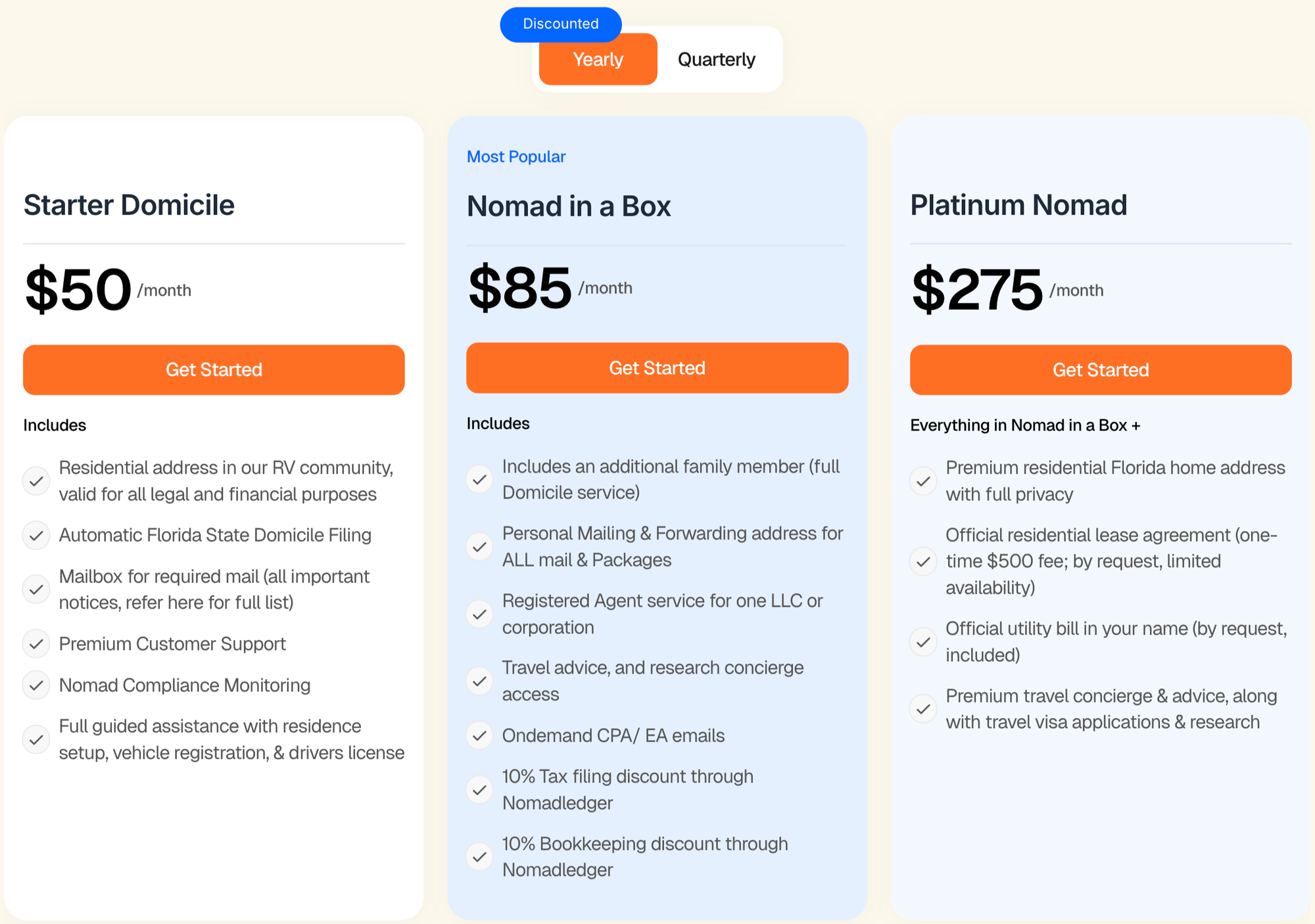
- Starting at $50/month (Starter Domicile plan)
Why residential address matters: Florida (and other states) require residential addresses for driver's license, voter registration, and establishing legal domicile. Commercial mailboxes don't qualify.
2. Visit Florida for 3-5 days
Schedule one trip to Florida to complete these steps:
Day 1-2: Get Florida driver's license
- Visit Florida DMV
- Bring: Passport, Social Security card, two proofs of Florida address
- Surrender Kansas license
- Cost: $54 for 8-year license
Day 2-3: File Declaration of Domicile
- Visit county Clerk of Court
- File notarized Declaration of Domicile
- Creates legal record of Florida as permanent home
- Cost: $10-30
- Critical for defending against Kansas's claims
Day 3-4: Additional optional steps
- Register to vote in Florida
- Open Florida bank account
- Register vehicle in Florida (if applicable)
3. Update all addresses to Florida
Critical step—update Florida address with:
- IRS (Form 8822)
- All banks and credit cards
- Investment/retirement accounts
- Insurance companies
- Employer/clients
- Social Security Administration
- Professional licenses
4. Maintain Florida abode year-round
This is critical for defending against Kansas's 183-day rule: You must demonstrate your primary home is in Florida, not Kansas.
How NomadPilot satisfies this:
- Florida residential address maintained 365 days/year
- Lease agreement proves ongoing abode
- Mail forwarding ensures you receive all correspondence
- Address remains valid whether you're in Portugal, Thailand, or traveling
Complete guide: How to Establish Florida Residency as a Digital Nomad
Step 2: Sever ALL Ties with Kansas
Establishing new domicile is only half the battle. You must also eliminate Kansas ties.
Critical Actions to Sever Kansas Ties
1. Property: ✅ Sell Kansas residence (clearest break)
✅ OR lease it long-term (document as investment property, not personal residence)
✅ OR clearly establish it's not your primary home (if keeping for occasional visits)
2. Financial ties: ✅ Close Kansas bank accounts or change address to Florida
✅ Update all financial institutions to Florida address
✅ Change credit card billing to Florida
3. Government documents: ✅ Surrender Kansas driver's license (automatic when getting Florida license)
✅ Cancel Kansas voter registration (automatic when registering in Florida)
✅ Transfer vehicle registration to Florida
4. Professional/personal ties: ✅ Transfer healthcare providers to Florida (or international)
✅ Cancel Kansas gym memberships, subscriptions
✅ Update professional licenses to Florida address
✅ Change will/estate documents to show Florida domicile
5. Employment: ✅ Notify employer of address change
✅ Update payroll to reflect Florida address
✅ Ensure Kansas withholding stops (Florida has no state withholding)
The goal: No one examining your situation should conclude Kansas is your permanent home.
Step 3: Understand and Comply with Kansas's 183-Day Rule
This is common among many states and critical for anyone who wants to visit Kansas after moving.
What Is the 183-Day (6-Month) Presumption?
According to Kansas Department of Revenue guidance, spending more than 183 days (approximately 6 months) in Kansas during a tax year creates a presumption that you are a resident for tax purposes.
How it works:
Scenario 1: You establish Florida domicile but spend 200 days in Kansas
- Days in Kansas: 200
- Result: Kansas presumes you're a resident
- You owe Kansas tax on worldwide income
- Burden of proof is on you to show Kansas wasn't your domicile
Scenario 2: You establish Florida domicile and spend 150 days in Kansas
- Days in Kansas: 150
- Result: Below 183-day threshold
- Combined with Florida domicile, strong nonresident position
- Kansas cannot easily claim you're a resident
Scenario 3: You spend 120 days in Kansas but never established domicile elsewhere
- Days in Kansas: 120
- But Kansas is still your domicile (you didn't properly change it)
- Result: Kansas resident (based on domicile, not days)
- Owe Kansas tax on worldwide income
Key point: The 183-day rule is a presumption, not an absolute rule. But it shifts the burden of proof.
Understanding the Two-Pronged Test
Kansas determines residency based on:
Prong 1: Domicile
- Where is your permanent home?
- Where do you intend to return?
- What state are you "from"?
Prong 2: Physical Presence (183-day rule)
- Did you spend 183+ days in Kansas?
- If yes, presumed resident (even with out-of-state domicile)
- If no, presumption doesn't apply
You're a Kansas resident if EITHER applies:
- Kansas is your domicile (regardless of days)
- OR you spend 183+ days in Kansas (regardless of domicile)
Example scenarios:
| Domicile | Days in KS | Result |
|---|---|---|
| Kansas | 90 days | KS Resident (domicile controls) |
| Florida | 200 days | KS Resident (183-day presumption) |
| Florida | 150 days | Nonresident (neither test triggers) |
| Kansas (never changed) | 0 days | KS Resident (domicile controls) |
The safest approach: Change domicile to Florida AND stay under 183 days in Kansas.
Strategic Planning for Kansas Visits
183 days = approximately 6 months. You can spend up to 182 days in Kansas without triggering the presumption.
Example visit schedules:
| Visit Pattern | Annual Days | Status |
|---|---|---|
| Monthly long weekends (12 visits × 4 days) | 48 days | Safe ✅ |
| Monthly week-long visits (12 visits × 7 days) | 84 days | Safe ✅ |
| Summer visits (June-August = 3 months) | ~90 days | Safe ✅ |
| 5-month visit (May-September) | ~150 days | Safe (under 183) ✅ |
| 6-month visit | ~180 days | Just under threshold ⚠️ |
| 7-month visit | ~210 days | Triggers presumption ❌ |
Key insight: You can spend significant time in Kansas (up to 5-6 months) as long as:
- You establish and maintain domicile elsewhere (Florida)
- You track days carefully
- You stay under 183 days
- You maintain strong ties to your new domicile state
Tracking Your Kansas Days
Keep detailed records:
- Flight/train tickets
- Hotel receipts
- Credit card statements showing locations
- Calendar noting Kansas days
- Photos with date/location stamps
Use a spreadsheet or app to count:
- Each day spent in Kansas
- Running total throughout year
- Alert when approaching 183 days
If Kansas audits you, these records prove your day count.
What Happens If You Exceed 183 Days?
You create a presumption of Kansas residency.
Kansas will likely:
- Treat you as resident for tax purposes
- Tax your worldwide income
- Require you to prove Kansas wasn't your domicile
Burden of proof shifts to you to show:
- You maintained domicile elsewhere
- Your presence in Kansas was not to establish domicile
- Your economic/family ties are in other state
- You intended to leave Kansas
This is difficult to prove and invites audit.
Better approach: Stay under 183 days and avoid the presumption entirely.
Step 4: Handle Kansas-Source Income (If Applicable)
Even after leaving Kansas residency, you may owe Kansas tax on Kansas-source income.
What Is Kansas-Source Income?
As a nonresident, Kansas taxes:
- Wages for work performed in Kansas
- Business income from Kansas operations
- Rental income from Kansas property
- Sale of Kansas real estate
Kansas does NOT tax (for nonresidents):
- Wages for work performed outside Kansas
- Investment income (unless from Kansas sources)
- Retirement distributions (unless from Kansas employers)
Filing as a Kansas Nonresident
If you have Kansas-source income:
1. File Kansas Form K-40 (nonresident)
- Report only Kansas-source income
- Claim credit for taxes paid to your new state (if applicable)
2. Provide documentation
- Proof of domicile change (Florida driver's license, Declaration of Domicile)
- Day-count documentation (if spending significant time in Kansas)
- Evidence of severed Kansas ties
Example: Managing Kansas Rental Property
Lisa's situation:
- Moved from Kansas to Florida (established FL domicile)
- Kept Kansas rental property generating $24,000/year
- Lives in Thailand as digital nomad, earns $110,000 remotely
Tax obligations:
- Federal: Full $134,000 taxable (minus FEIE if applicable)
- Florida: $0 (no state income tax)
- Kansas: Tax only on $24,000 rental income
- Thailand: Depends on tax residency status
Annual Kansas tax: ~$1,230 (just on rental income)
vs. if she kept Kansas domicile:
- Kansas tax on full $134,000: ~$7,350/year
- Annual savings from FL domicile: $6,120
How NomadPilot Makes Leaving Kansas Residency Simple
Leaving Kansas residency requires proper infrastructure, documentation, and ongoing compliance.
NomadPilot provides everything you need:
Florida Residential Address
Legitimate street address that:
- Qualifies for Florida domicile establishment
- Passes Florida DMV requirements
- Works for bank verification
- Acceptable to IRS
NOT:
- PO Box
- Commercial mail receiving agency (CMRA)
- Temporary address
Three plan options:
Mail Scanning and Worldwide Forwarding
Never miss important correspondence:
- Scan all mail digitally
- Access online from anywhere
- Forward selectively to current location
- Hold mail as long as needed
Critical for Kansas nonresidents:
- Receive Kansas tax notices promptly
- Stay on top of rental property correspondence
- Maintain Florida address on all accounts
Declaration of Domicile Support
File with Florida county Clerk of Court:
- Document templates
- Filing instructions
- Legal record of domicile change date
Ongoing Compliance Support
Maintain Florida domicile while:
- Living abroad
- Traveling full-time
- Visiting Kansas regularly (under 183 days)
- Managing Kansas property
Tax Professional Network
Connect with CPAs experienced in:
- Kansas final returns
- Florida domicile establishment
- Multi-state tax issues
- Expat tax planning
Learn more: NomadPilot Florida Residency Services
Filing Your Final Kansas Tax Return
When you change domicile, file a part-year resident Kansas return.
What to Include
Your final Kansas return should show:
- Income earned while Kansas resident (Jan 1 through domicile change date)
- Your new Florida address
- Clear statement: "Taxpayer established domicile in Florida on [date]"
- Pay any Kansas tax owed through move date
Example:
- You moved July 1, 2026
- Report Kansas resident income: Jan 1 - June 30
- Report Kansas nonresident income: July 1 - Dec 31 (Kansas-source only)
After this return, you only file Kansas returns if you have Kansas-source income (rental property, business, etc.).
Common Mistakes When Leaving Kansas Residency
Mistake #1: Not Establishing Proper Domicile Elsewhere
Problem: Just moving to another state without formal domicile establishment
Result: Kansas continues to claim you as resident
Solution: Properly establish Florida domicile with driver's license, Declaration of Domicile, and documented ties
Mistake #2: Spending 183+ Days in Kansas
Problem: Exceeding 6-month threshold
Result: Triggers residency presumption, owe Kansas tax on worldwide income
Solution: Track days carefully, stay under 183 days
Mistake #3: Not Severing Kansas Ties
Problem: Keeping Kansas driver's license, voter registration, bank accounts
Result: Kansas claims you never truly left
Solution: Sever ALL significant Kansas ties
Mistake #4: Not Filing Final Kansas Return
Problem: Just stop filing after moving
Result: Kansas assumes you're still resident, assesses back taxes
Solution: File proper part-year resident return declaring domicile change
Mistake #5: Using CMRA or PO Box for New Address
Problem: Getting commercial mailbox instead of residential address
Result: May not qualify for driver's license or domicile establishment
Solution: Use legitimate residential address (NomadPilot provides this)
Common Questions About Leaving Kansas Residency
Can I leave Kansas residency if I still own property there?
Yes. Owning property doesn't determine domicile. However, if it's your only property, it suggests Kansas remains your domicile. Best practice: Lease it long-term or sell it. If keeping it, clearly establish it's investment property, not your residence.
How does the 183-day rule work exactly?
If you spend more than 183 days (approximately 6 months) in Kansas during a tax year, Kansas presumes you're a resident for tax purposes—even if you've established domicile elsewhere. You can try to overcome this presumption, but the burden of proof is on you.
Can I spend summers in Kansas (5 months)?
Yes. 5 months = ~150 days, well under the 183-day threshold. Combined with strong Florida domicile (driver's license, Declaration of Domicile, Florida address), you should be fine.
What if I work remotely and my employer is in Kansas?
If you're working from Florida (or abroad), that's Florida-source income (or foreign), not Kansas-source. Kansas only taxes Kansas-source income for nonresidents. Update your employer to withhold for Florida (no withholding) and stop Kansas withholding.
Do I need to visit Florida regularly to maintain domicile?
No minimum visit requirement after initial establishment. You can travel worldwide while maintaining Florida domicile via NomadPilot's address and mail forwarding services. What matters is your intent and legal ties (license, voter registration, address).
What happens if Kansas audits me?
Provide documentation: Florida driver's license, voter registration, Declaration of Domicile, signed lease, day-count tracking, proof you severed Kansas ties. Proper setup from day one (via NomadPilot) prevents audit issues.
Can I change my mind and move back to Kansas later?
Yes. You can always re-establish Kansas domicile by moving back, getting Kansas driver's license, etc. But you'll start owing Kansas tax again on worldwide income.
How long does Kansas have to audit my residency change?
Generally 3 years from filing date. Keep all domicile documentation for at least 4-5 years after your move.
Does Kansas honor the Foreign Earned Income Exclusion?
Kansas follows federal adjusted gross income (AGI), so if you exclude foreign earned income at the federal level using FEIE, it flows through to Kansas and is generally excluded from Kansas taxation. However, you still must properly change domicile to stop being a Kansas resident in the first place.
Conclusion: Leave Kansas Residency the Right Way
Leaving Kansas residency isn't just about moving—it's about properly establishing domicile elsewhere and severing Kansas ties.
The benefits are substantial:
- Eliminate Kansas state income tax ($1,800-$11,000+/year)
- Gain flexibility to visit Kansas (under 183-day threshold)
- Maintain legal US address for banking/compliance
- Simplify tax filing
- Warmer weather year-round (Florida)
The process is straightforward:
Step 1: Establish Florida domicile (3-5 day visit)
Step 2: Sever ALL Kansas ties
Step 3: Track Kansas visits (stay under 183 days)
Step 4: File final Kansas return
The investment: Starting at $50/month for NomadPilot Starter Domicile = $1,800-$11,000/year in tax savings
ROI: Pays for itself in days or weeks
Don't delay: Every month as a Kansas resident costs you in unnecessary state taxes.
Ready to leave Kansas residency and eliminate state income tax?

Visit NomadPilot.io to:
- Get Florida residential address (starting at $50/month)
- Establish legal Florida domicile
- Set up mail forwarding worldwide
- Access Kansas domicile change guidance
- Connect with tax professionals
- Start saving thousands annually
Leave Kansas residency the smart way—with proper documentation, ongoing compliance support, and the freedom to visit family while eliminating state income tax.