How to Maintain a US Address While Living Abroad as an Expat
Maintain a US address while living abroad for banking, taxes, and legal compliance. Learn the three options—family address, virtual mailbox, and professional domicile services—and why Florida residency saves expats thousands.

Moving abroad is one of life's greatest adventures—new cultures, new experiences, and the freedom to explore the world while working remotely or pursuing opportunities overseas.
But there's one practical reality that catches many American expats off guard: you still need a US address.
Even if you plan to spend years living in Barcelona, Bangkok, or Buenos Aires, US banks, the IRS, state governments, and countless institutions require a valid US residential address on file. Without one, you'll face frozen bank accounts, rejected credit card applications, tax compliance issues, and administrative nightmares.
This comprehensive guide explains why maintaining a US address is essential for expats, what your options are, how to choose the right solution, and how to ensure your address setup works for all your banking, tax, and legal needs.
Why US Citizens Living Abroad Still Need a US Address
Let's address the fundamental question: if you're living in another country, why do you need a US address at all?
The answer lies in how American systems are designed. Unlike many countries, the US maintains extensive oversight and requirements for its citizens regardless of where they live.
Legal and Tax Requirements
Federal tax filing
The United States is one of only two countries (along with Eritrea) that taxes based on citizenship rather than residency. According to the IRS, all US citizens must file annual tax returns regardless of where they live or earn income.
You need a US address to:
- Receive IRS correspondence and audit notices
- File Form 1040 (US Individual Income Tax Return)
- Receive tax refund checks (if not using direct deposit)
- Respond to IRS inquiries without international mail delays
State tax obligations
Many states continue to claim tax jurisdiction over former residents who move abroad. This is especially true for "sticky states" like California, New York, Virginia, and South Carolina.
Having a US address helps you:
- Establish legal domicile in a tax-free state before leaving
- File final returns with your old state
- Prove you've severed ties with high-tax states
- Maintain domicile in your new chosen state
For more on this topic: Do Digital Nomads Have to Pay State Taxes?
Voting registration
The Federal Voting Assistance Program allows US citizens abroad to vote using absentee ballots. However, you must be registered in a US state to vote in federal, state, and local elections.
Requirements:
- US residential address for voter registration
- Last state of residence determines your voting jurisdiction
- Absentee ballot requests require current US address on file
Legal domicile maintenance
Every US citizen has a legal domicile—a permanent home state for legal purposes. According to state law precedents (such as Mitchell v. United States and various state Supreme Court rulings), maintaining legal domicile requires:
- Intent to return to that state as your permanent home
- Physical address in that state
- Documentation supporting your domicile claim
Without proper domicile, you risk being claimed as a resident by multiple states simultaneously, leading to double taxation.
Banking and Financial Requirements
US bank account maintenance
Most major US banks require a US residential address to maintain checking and savings accounts. The Bank Secrecy Act and Know Your Customer (KYC) regulations mandate that banks verify customer addresses.
What banks require:
- Residential street address (not a PO Box)
- Ability to receive correspondence at that address
- Address verification through AVS (Address Verification Service)
- Updated address information when you move
Using a foreign address often triggers:
- Account closure warnings or actual closures
- Inability to open new accounts
- Loss of credit card privileges
- Restricted access to online banking
- Compliance reviews and holds
Major banks like Chase, Bank of America, and Citibank have different policies, but most require US addresses for US-based accounts.
Credit cards and credit score
Maintaining a US credit score is critical for future financial flexibility, whether you return to the US or need credit for international transactions.
Requirements for credit:
- US billing address for credit card accounts
- Ability to receive statements and notices
- Consistent address across credit bureaus (Equifax, Experian, TransUnion)
Foreign addresses cause problems:
- Credit card application rejections
- Existing card closures
- Difficulty disputing charges
- Credit score deterioration from closed accounts
Investment and brokerage accounts
Firms like Fidelity, Vanguard, and Charles Schwab require US addresses for:
- IRS tax reporting (Form 1099s)
- Regulatory compliance
- Account statements and communications
- Shareholder voting materials
FATCA compliance
The Foreign Account Tax Compliance Act (FATCA) requires US citizens to report foreign financial accounts. Having a US address helps with:
- Filing FBAR (FinCEN Form 114)
- Filing Form 8938 (foreign asset reporting)
- Receiving IRS correspondence about foreign accounts
Related: FBAR for US Expats: What to File, When It's Required, and How to Stay Organized
Personal and Professional Needs
Receiving important mail and packages
Even living abroad, you'll need to receive:
- Government correspondence (IRS, Social Security, Medicare)
- Financial statements (bank, investment, retirement accounts)
- Legal documents (contracts, court notices, official notifications)
- Professional licenses and certifications
- Online shopping deliveries (many US retailers don't ship internationally)
Business operations
For freelancers, contractors, and business owners:
- LLC or corporation registration requires a US registered agent address
- Many US clients require a US address for Form 1099 reporting
- Business banking requires US business address
- Professional liability insurance often requires US address
- Contracts and invoices look more credible with US address
Driver's license and vehicle registration
If you maintain a US driver's license or vehicle:
- Renewal notices sent to your address
- Vehicle registration requires state address
- Insurance policies require US address
State-specific benefits
Maintaining state domicile provides access to:
- In-state tuition rates (for family members)
- State professional licenses
- State healthcare programs (in some cases)
- Resident hunting/fishing licenses
- State park passes and resident discounts
Family and social connections
Practical considerations:
- Emergency contacts often require US address
- Healthcare providers and insurance want US address on file
- Magazine subscriptions and memberships
- Alumni associations and professional organizations
- Backup address for family to use for gifts or correspondence
Your Options for Maintaining a US Address as an Expat
You have three main approaches, each with distinct advantages and drawbacks.
Option 1: Using a Friend or Family Member's Address
This is the most common starting point for expats.
How it works:
- Use their residential address as your official US address
- They receive your mail and forward important items
- You update all institutions with their address
| Pros | Cons |
|---|---|
| Free or very low cost | Burden on your friend/family member |
| Someone you trust handles your mail | They see all your sensitive mail (bank statements, tax documents) |
| Real residential address that passes verification | Dependent on their reliability and availability |
| Can receive packages and physical mail | Mail may be delayed, lost, or mishandled |
| Easy initial setup | They must manually scan, photograph, or forward items |
| Works for all legal purposes | You may establish unwanted domicile in their state |
| - | No professional management or organization |
| - | Relationship strain from frequent requests |
| - | Stops working if they move or relationship changes |
Critical consideration: If you use a family member's address in a high-tax state like California or New York, you may inadvertently establish domicile there and owe state income tax on your worldwide income.
Best for:
- Short-term expats (1-2 years)
- Those with very reliable family in tax-free states
- People who receive minimal mail
- Expats planning to return soon
Not recommended for:
- Long-term expats (3+ years)
- Those whose family lives in high-tax states
- Anyone receiving significant sensitive mail
- Professional situations requiring privacy
Option 2: Virtual Mailbox Services
Virtual mailboxes provide a physical mailing address where your mail is received, scanned, and made available online.
How it works:
- Sign up for service and receive a street address
- All mail is received at that address
- Staff scan envelope (and contents if requested)
- You view mail online and request forwarding for important items
Popular providers:
- US Global Mail
- Traveling Mailbox
- PostScan Mail
- Earth Class Mail
- Anytime Mailbox
| Pros | Cons |
|---|---|
| Professional mail management | Monthly/annual fees ($10-50+/month) |
| View mail online from anywhere | Often flagged as commercial addresses, not residential |
| Can forward physical mail worldwide | May not be accepted by banks for account verification |
| Package receiving capabilities | Rejected by some DMVs for driver's license |
| Choose location (potentially in tax-free state) | Additional fees for scanning contents, forwarding |
| No dependency on friends/family | May not support legal domicile establishment |
| Privacy from personal relationships | Service quality varies, potential mail delays |
| Professional appearance for business | No proof of residency documents (no lease, utilities) |
The critical flaw: Most virtual mailbox addresses are commercial addresses, not residential. Banks run Address Verification Service (AVS) checks that flag these as mail drops. This means:
❌ Banks may reject them for new account applications
❌ Existing accounts may be flagged for review
❌ DMVs often don't accept them for driver's license
❌ You can't establish legal domicile with them
❌ May not satisfy proof of residency requirements
Best for:
- Receiving general correspondence and packages
- Mail scanning and digital access
- Temporary solution while establishing proper domicile
- Supplemental to a real residential address
Not recommended for:
- Primary address for banking
- Establishing legal domicile
- DMV/driver's license applications
- Situations requiring proof of residency documents
Option 3: Professional Domicile Services
Domicile services provide a residential street address specifically designed for expats who need to establish and maintain legal state residency while living abroad.
How it works:
- Service provides a legitimate residential address in a chosen state (typically Florida, South Dakota, or Texas)
- Address passes bank verification as residential, not commercial
- Includes supporting documents (lease agreement, utility bills)
- Provides mail forwarding and scanning
- Offers guidance for establishing legal domicile
- May include access to expat tax professionals and legal support
What makes domicile services different:
Unlike virtual mailboxes, domicile services provide: ✅ True residential addresses that pass AVS verification
✅ Lease agreements in your name for proof of residency
✅ Utility bills (optional) for stricter verification requirements
✅ Domicile establishment guidance for legal compliance
✅ Tax optimization in states with no income tax
✅ Long-term stability designed for permanent expat situations
| Pros | Cons |
|---|---|
| Real residential address accepted by banks | Higher cost than virtual mailboxes ($200-600+/year) |
| Establish domicile in tax-free state (save thousands annually) | Requires initial setup process and documentation |
| Lease agreement and proof of residency documents | Must visit state at least once for driver's license |
| Mail forwarding and scanning included | - |
| Legal domicile support and guidance | - |
| Works for DMV, banks, IRS, voting | - |
| Professional management and compliance monitoring | - |
| Access to expat CPAs and tax professionals | - |
| Long-term solution (stable for years) | - |
| No dependency on friends/family | - |
Best for:
- Long-term expats (3+ years abroad)
- High earners who benefit from state tax savings
- Those leaving high-tax states like California or New York
- Expats who need banking and legal compliance
- Digital nomads without fixed international address
- Anyone wanting professional, comprehensive solution
The ROI calculation:
If you earn $100,000/year and previously had domicile in California (9.3% state tax):
- Annual California state tax: ~$9,300
- Domicile service cost: ~$400/year
- Net annual savings: $8,900
- ROI: 2,225%
Over 10 years abroad, that's $89,000 in savings.
How to Establish Legal Domicile in a Tax-Free State from Abroad
The smartest approach for most expats is establishing legal domicile in a state with no income tax before or shortly after moving abroad.
Best States for Expat Domicile
| State | Income Tax | Initial Visit Required | Best For Expats |
|---|---|---|---|
| Florida | 0% | Yes (DMV visit) | Most expats - best infrastructure |
| South Dakota | 0% | Yes (1 night stay) | RVers, those passing through Midwest |
| Texas | 0% | Yes (30 days required) | Those with Texas connections |
| Nevada | 0% | Yes (30 days required) | Western US connections |
| Wyoming | 0% | Yes (DMV visit) | Business owners (great LLC laws) |
Florida is the most popular choice for expats because:
- No state income tax
- No minimum days-per-year requirement
- Straightforward domicile process
- Best mail forwarding infrastructure
- Major international airports for visits
- Strong asset protection laws
- Established expat community
For a complete state comparison: Best US States for Digital Nomad Residency
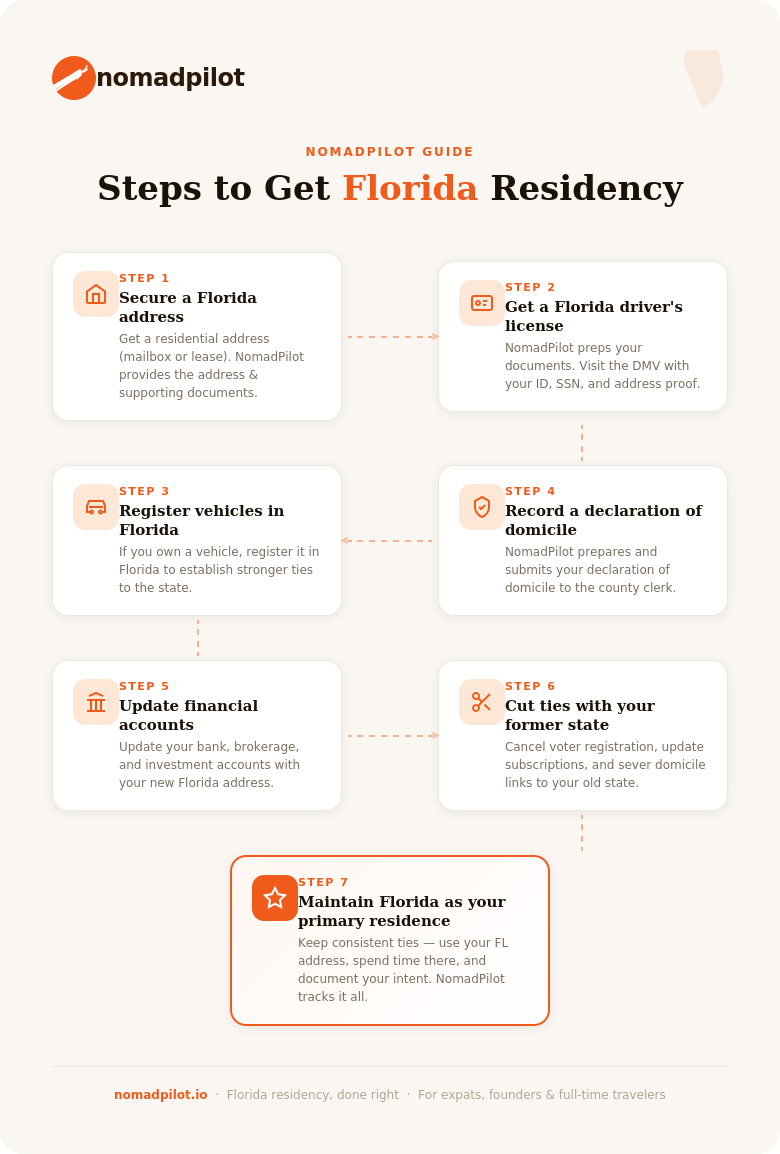
Step-by-Step: Establishing Florida Domicile Before/While Living Abroad
Timeline: Can be completed in one 3-5 day visit to Florida
Step 1: Obtain a Florida residential address (do this before visiting)
- Use a professional domicile service like NomadPilot
- Or arrange short-term rental/room lease
- Must be a street address, not a PO Box
Step 2: Visit Florida for 3-5 days
During your visit:
Day 1-2: Get Florida driver's license
- Visit any Florida DMV
- Bring: Passport, Social Security card, two proofs of Florida address
- Surrender your out-of-state license
- Receive Florida driver's license (most important domicile document)
Day 2-3: Register to vote
- Can be done online at RegisterToVoteFlorida.gov
- Or in person at DMV
- Use your Florida address
Day 3: File Declaration of Domicile
- File with Clerk of Court in your Florida county
- Cost: $10-30
- Must be notarized
- Creates legal record of domicile intent
Day 4: Register vehicle (if applicable)
- If you own a vehicle, register it in Florida
- Or sell/register vehicle before leaving US
Day 5: Open Florida bank account (optional but recommended)
- Local bank or credit union account strengthens domicile
- Use as backup/secondary account
Step 3: Update all institutions with Florida address (before or after visit)
- IRS (Form 8822)
- All banks and credit cards
- Investment/brokerage accounts
- Insurance providers
- Employer (if remote working for US company)
- Social Security Administration
- Medicare (if applicable)
Step 4: File final tax return with old state (if leaving a different state)
- Part-year resident return
- Show move date to Florida
- Include Florida address
- Pay any tax owed through move date
Step 5: Maintain domicile while abroad
- Keep Florida driver's license current (renew by mail or during visits)
- Maintain mail forwarding service
- Use Florida address on all tax returns
- Don't establish domicile elsewhere
- Visit Florida occasionally if practical (not required, but helpful)
Complete guide: How to Establish Florida Residency as a Digital Nomad
Special Considerations for Expats
Banking Challenges for Expats
Living abroad creates unique banking difficulties. Many expats face:
FATCA complications: Foreign banks often don't want US citizen customers due to FATCA reporting requirements
US bank restrictions: Some US banks close accounts for customers with foreign addresses or extended foreign residence
Solution: Maintain US domicile address with mail forwarding, use banks friendly to expats (Charles Schwab, Ally Bank, Capital One 360), consider both US and foreign accounts
Mail Forwarding Internationally
Key considerations:
Forwarding costs: International shipping is expensive ($30-100+ per package)
Customs and duties: Packages may incur fees when entering your country
Delivery reliability: Some countries have less reliable postal systems
Digital-first approach: Use services that scan mail so you only forward truly necessary items
Pro tip: Have non-urgent items held and forwarded in batches every few months to reduce shipping costs
Tax Filing from Abroad
Federal taxes:
- File Form 1040 by April 15 (automatic 2-month extension for expats to June 15)
- Request additional extension to October 15 if needed (Form 4868)
- Claim Foreign Earned Income Exclusion if eligible (Form 2555)
- Report foreign accounts (FBAR and Form 8938)
State taxes:
- File final return with your old state when you establish new domicile
- File with Florida (no return required - no income tax)
- Keep documentation proving domicile change
US address importance:
- IRS sends notices to address on file
- Refund checks mailed to your address (if not using direct deposit)
- Audit notices sent by mail
- Missing IRS correspondence can trigger penalties
Related: Why 'Tax-Free Countries' Don't Mean Tax-Free for Americans
Healthcare and Insurance
US address needed for:
- Medicare enrollment and correspondence
- US health insurance policies (if maintaining coverage)
- Travel insurance applications
- Life insurance policies
- Disability insurance
Considerations:
- Medicare doesn't cover care outside the US (except limited exceptions)
- Many expats use international health insurance (Cigna Global, GeoBlue, IMG Global)
- Maintain US address for future Medicare enrollment
Social Security and Benefits
Direct deposit recommended: Avoid checks being mailed to US address then forwarded internationally
Address on file: Social Security Administration needs current US address for:
- Benefit statements
- Tax documents (SSA-1099)
- Correspondence about benefits
International living: You can receive Social Security benefits in most countries while living abroad (SSA country list)
Driver's License Maintenance
Renewal while abroad:
- Florida allows mail-in renewal in some cases
- Some states require in-person renewal
- Plan visits home around renewal dates
- International Driver's Permit supplements US license for foreign driving
Expiration consequences:
- Expired license weakens domicile claim
- Can't use as ID for domestic travel when visiting US
- May complicate return to US
Employment Considerations
W-2 employees working for US companies remotely:
- Employer needs US address for payroll
- Tax withholding based on address state
- Florida domicile means no state tax withholding
1099 contractors and freelancers:
- Clients need US address for tax reporting
- Business address requirements
- Professional credibility with US address
Foreign employment:
- Still need US address for IRS correspondence
- Foreign Earned Income Exclusion eligibility
- Foreign tax credits
How NomadPilot Solves the Address Challenge for Expats
Living abroad shouldn't mean losing access to US banking, facing tax complications, or dealing with mail forwarding headaches. NomadPilot provides a complete solution designed specifically for American expats.
Florida Residential Address
Get a legitimate residential street address in Florida that:
- Passes bank Address Verification Service (AVS) checks
- Meets DMV requirements for driver's license
- Satisfies IRS and government agency standards
- Isn't flagged as commercial mail drop
Signed Lease Agreement
Receive a professionally drafted lease in your name providing:
- Proof of residency for banks
- DMV documentation requirement
- Legal support for domicile establishment
- Professional appearance for all institutions
Optional Utility Bill
Upgrade to include utility bills in your name:
- For institutions with stricter verification requirements
- Premium proof of residency documentation
- Meets "gold standard" address verification
Mail Scanning and Worldwide Forwarding
Never miss important correspondence:
- We receive all mail at your Florida address
- Scan and digitize for online viewing
- Forward selectively to any country
- Manage everything from your dashboard
- Secure document storage
Florida Domicile Establishment Support
Step-by-step guidance including:
- Pre-visit preparation checklist
- DMV appointment coordination
- Declaration of Domicile filing assistance
- Document templates and instructions
- Address update checklist for institutions
Expat Tax Professional Network
Connect with CPAs who understand:
- Foreign Earned Income Exclusion
- FBAR and FATCA reporting
- State domicile changes
- International tax treaties
- Expat-specific deductions
Compliance Monitoring
Stay on top of requirements:
- Driver's license renewal reminders
- Tax filing deadline notifications
- Domicile maintenance best practices
- Regulatory changes affecting expats
Long-Term Stability
Unlike temporary solutions:
- Maintain same address for years
- No dependency on friends/family
- Professional service continuity
- Scalable as your needs change
The NomadPilot Advantage:
Florida domicile through NomadPilot provides: ✅ $0 state income tax (save $5,000-$15,000+ annually)
✅ Real residential address accepted everywhere
✅ Professional mail management from anywhere
✅ Legal domicile documentation
✅ Expat-focused support and guidance
✅ One-time setup, maintain indefinitely
Learn more: NomadPilot Florida Residency for Expats
Common Questions About Maintaining US Address While Living Abroad
Do I legally need a US address if I live abroad permanently?
While there's no law requiring US citizens to have a US address, practical necessity makes it essential. The IRS, banks, state governments, and countless institutions require US addresses for compliance. Without one, you'll face account closures, tax complications, and administrative barriers.
Can I use a PO Box as my US address?
Generally no. Most institutions require a residential street address, not a PO Box. The IRS allows PO Boxes for mailing purposes, but banks, DMVs, and many agencies specifically prohibit them for address verification.
Will using a friend's address establish domicile in their state?
Potentially yes. Using someone's address, combined with other factors (spending time there, having ties there), can create domicile in that state. This is why many expats specifically establish domicile in tax-free states rather than using high-tax state addresses.
How often do I need to visit my domicile state?
Florida has no minimum visit requirement. Once domicile is established, you can live abroad indefinitely. However, occasional visits (every few years) strengthen your domicile claim, especially if you're from a "sticky state" that might challenge your move.
Can I maintain domicile in one state but live in another country?
Yes. Domicile is your permanent legal home—the state you intend to return to. Physical presence in that state isn't required. You can maintain Florida domicile while living in Portugal, Thailand, Mexico, or anywhere else.
What if my old state audits me after I move abroad?
States like California and New York sometimes audit former residents who claim to have left. You'll need documentation proving your new domicile:
- Florida driver's license
- Declaration of Domicile
- Updated bank/financial accounts
- Voter registration
- Final part-year tax return
- Evidence of severed ties with old state
Proper documentation from the start prevents problems.
How do I receive Social Security benefits while living abroad?
Social Security can direct deposit benefits to US or foreign bank accounts. You need a US address on file for correspondence, but you receive benefits in most countries. Check the SSA payments abroad page for country-specific rules.
Can I vote in US elections from abroad?
Yes. Register to vote in your state of domicile and request absentee ballots through the Federal Voting Assistance Program. Your vote counts in your domicile state's federal, state, and local elections.
What happens to my US address if I move back to the US?
You can change your domicile anytime by establishing residency in a new state. If you return to the US, update your address with all institutions, get a new driver's license, and file tax returns with your new state. Your Florida domicile service can be canceled or maintained as backup.
Do I pay US taxes on foreign income?
Yes, US citizens pay federal tax on worldwide income regardless of where they live. However, you may qualify for:
- Foreign Earned Income Exclusion (exclude up to $126,500 of earned income)
- Foreign Housing Exclusion/Deduction
- Foreign Tax Credits
These can significantly reduce or eliminate US tax on foreign income. Working with an expat CPA is essential.
Conclusion: Don't Let Address Issues Complicate Your Expat Life
Living abroad is an incredible opportunity, but maintaining connection to US systems is essential for banking, taxes, voting, and legal compliance.
The right address strategy depends on your situation:
Short-term expats (1-2 years): Friend/family address may work if they're reliable and in a tax-friendly state
Long-term expats (3+ years): Professional domicile service provides stability and tax savings
High earners leaving high-tax states: Establishing Florida domicile before leaving is critical—saves thousands annually
Digital nomads without fixed foreign address: Florida domicile provides stability both for US requirements and as permanent legal home
The investment in a proper address solution is minimal compared to the cost of:
- Frozen bank accounts
- State tax audits and back taxes
- Missing important IRS correspondence
- Inability to maintain credit
- Administrative nightmares from inconsistent addresses
Don't wait until you're abroad and facing problems. Establish your US address and domicile before you leave, or as soon as possible after arriving overseas.
Ready to establish Florida domicile and eliminate state income tax while living abroad?
Visit NomadPilot.io to get your Florida residential address, mail forwarding, domicile support, and everything you need to maintain compliant US presence while living your best expat life.